
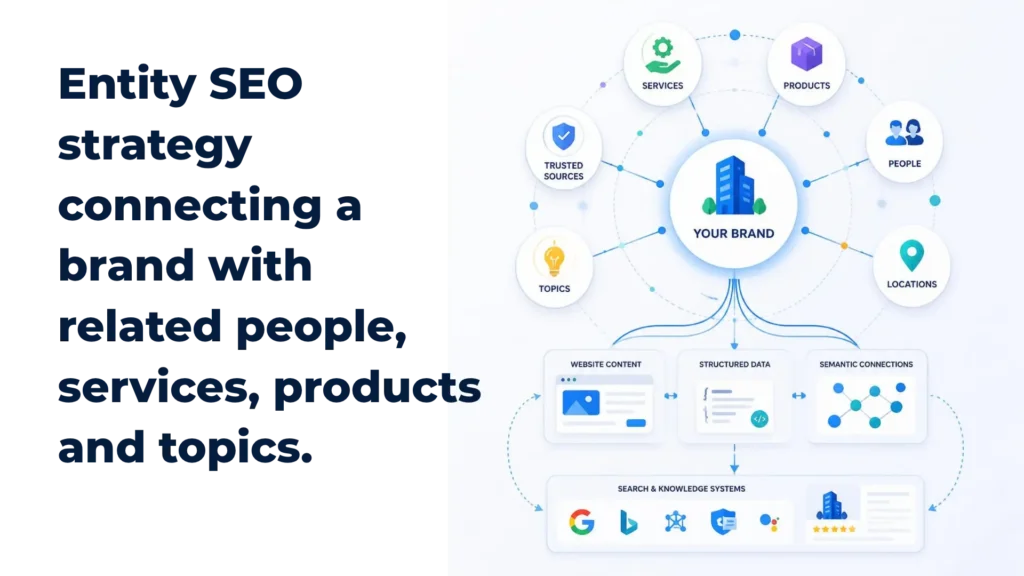
Entity SEO Services to Strengthen Your Brand’s Search Identity
Search engines no longer rely only on matching keywords with web pages. They also need to understand – who, what, where and how information is connected.
Your business is an entity. So are your products, services, locations, people, authors, organisations and the topics you are associated with.
Our Entity SEO Services help build clearer connections between these entities across your website and relevant sources across the web. We combine semantic SEO, content strategy, structured data, internal linking, entity relationships and authority signals to help search systems better understand your business and its place within your industry.
The goal is not to add keywords everywhere.
It is to create a clearer and more consistent digital identity around your brand.
What Is Entity SEO?
Entity SEO is an approach to search optimization that focuses on helping search engines understand entities and the relationships between them, rather than treating every search as a simple keyword-matching exercise.
An entity can be a clearly identifiable:
- Business
- Brand
- Person
- Product
- Service
- Location
- Organization
- Topic
- Place
- Event
For example, a digital marketing agency may be connected with entities such as:
Digital Marketing → SEO → Technical SEO → Content Strategy → AEO → GEO → Faridabad → India
A strong entity strategy helps establish these relationships through relevant content, site architecture, structured data, internal links and consistent information.
Google’s documentation explains that structured data can help it understand content on a page, while Organization structured data can help Google better understand and disambiguate an organization.
Why Entity SEO Matters
Search has evolved from understanding individual words to interpreting broader topics, relationships and context.
Consider the difference between –
“Apple”
and
“Apple iPhone 17 Pro Max”
The second query provides a much clearer entity context.
Similarly, a business website should make it clear:
- What the business is
- What it offers
- Who it serves
- Where it operates
- Which topics it specializes in
- Which people are associated with it
- Which products or services belong to it
- How its different pages relate to one another
Clear entity relationships can help create a more understandable website and a more consistent digital footprint.
Our Entity SEO Services
GEO should extend your search strategy into an evolving AI-driven search environment.
Entity Discovery & Mapping
We identify the important entities connected with your business and map how they relate to one another.
This can include:
- Brand entities
- Organization entities
- Products
- Services
- People
- Locations
- Industries
- Topics
- Subtopics
- Business categories
- Relevant external entities
The result is an entity map that provides a clearer foundation for your SEO strategy.
Brand Entity Optimization
Your brand should have a consistent identity across your website and relevant external sources.
We review how your brand is represented through:
- Business name
- Website
- About information
- Brand descriptions
- Contact information
- Business categories
- Social profiles
- Author profiles
- Relevant third-party references
The objective is to reduce ambiguity around your organization and create stronger consistency across your digital presence.
Entity-Based Content Strategy
Entity SEO goes beyond creating pages around isolated keywords.
We develop content around the entities, topics and relationships that matter to your audience.
This can include:
- Core topic pages
- Service pages
- Product pages
- Supporting educational content
- Entity-focused FAQs
- Author and expert content
- Comparison content
- Location information
- Industry resources
Instead of creating disconnected pages, we build relationships between them.
Semantic SEO
Semantic SEO focuses on the meaning and context surrounding a topic.
For example, a page about technical SEO may naturally relate to:
- Crawling
- Indexing
- Canonical URLs
- XML sitemaps
- Robots.txt
- JavaScript SEO
- Internal linking
- Structured data
- Core Web Vitals
These related concepts help provide context around the main subject.
Our semantic SEO strategy identifies the concepts that genuinely belong around your primary topics and incorporates them where they improve understanding and usefulness.
Entity Relationships & Topic Connections
Search systems need context to understand how different pieces of information relate.
We examine relationships such as:
- Brand → Service
- Brand → Location
- Person → Organization
- Product → Brand
- Service → Industry
- Article → Author
- Article → Topic
- Business → Location
- Product → Category
These relationships can be reinforced through content, links, structured data and consistent information.
Structured Data & Schema Implementation
Structured data provides standardized information about page content and entities.
We identify appropriate structured data opportunities and help implement relevant Schema.org types where they accurately represent the page.
Depending on the website, this may include:
- Organization
- LocalBusiness
- Person
- Product
- Service
- Article
- ProfilePage
- Breadcrumb
- Event
- Other relevant supported types
Google states that structured data can help it understand page content and that Organization structured data can help it understand and disambiguate an organization.
Structured data should accurately represent visible or otherwise appropriate information on the page. It is not a shortcut for creating an entity that does not genuinely exist.
Knowledge Graph & Entity Understanding
Search engines maintain systems that connect information about entities and their relationships.
Our Entity SEO strategy focuses on making your website’s information clearer and more consistent so search systems can better understand the entities represented on your site.
This includes reviewing:
- Entity names
- Descriptions
- Relationships
- Identifiers
- Relevant properties
- Supporting content
- Internal references
- External references
Entity SEO does not mean trying to force your business into a knowledge panel or guarantee inclusion in a particular search feature.
Internal Linking for Entity Relationships
Internal links are useful not only for navigation but also for connecting related information across your website.
We use contextual internal linking to establish relationships between:
- Core service pages
- Supporting articles
- Product pages
- Category pages
- Location pages
- Author pages
- Related topics
For example:
SEO Services → Technical SEO → Crawlability → Indexing → XML Sitemaps
This creates a logical information structure instead of a collection of isolated pages.
Content Consistency & Entity Signals
Your business information should not contradict itself across important sources.
We review relevant signals such as:
- Business name
- Website URL
- Business category
- Address
- Phone number
- Services
- Brand description
- Founders or key people
- Social profiles
- Business directories
- Industry profiles
For local businesses, this can also connect with Local SEO and Google Business Profile optimization.
Google’s LocalBusiness documentation explains that structured data can provide information such as business hours, departments and other business details.
Person & Author Entity Optimization
People can also be important entities within a website.
For businesses that rely on expertise and thought leadership, we can strengthen connections between:
Person → Role → Organization → Expertise → Content
This may include:
- Author pages
- Expert bios
- Relevant credentials
- Author links
- Content attribution
- Professional profiles
- Consistent author information
Google supports ProfilePage structured data for pages whose primary focus is an individual or organization associated with the website.
Product & Service Entity Optimization
For ecommerce and service businesses, we help establish clearer relationships between what the business sells and the broader categories those offerings belong to.
For example:
Brand → Product → Product Category → Use Case → Industry
or:
Agency → SEO Services → Technical SEO → Ecommerce SEO → Search Visibility
Where applicable, product structured data can provide Google with information such as product details, offers, reviews and availability.
Our Entity SEO Process
We identify the primary entities associated with your business, website and industry.
We map relationships between your brand, people, products, services, locations and topics.
We review your existing content, architecture, internal links, structured data and entity references.
We identify gaps, inconsistencies and opportunities across your website and relevant external sources.
We improve pages and internal relationships so important entities and topics are represented more clearly.
Where appropriate, we implement and validate relevant structured data that accurately represents the page.
We review relevant third-party references and business profiles - that contribute to the consistency of your digital identity.
Entity understanding is not a one-time technical task.
As your business, services, products and content evolve, your entity ecosystem should evolve with them.
What Entity SEO Can Help Improve
A well-structured entity strategy can support:
- Clearer business identity
- Better topical context
- Stronger website relationships
- More consistent business information
- Better structured content
- Improved search-engine understanding
- Stronger semantic relevance
- Better alignment between content and entities
- A stronger foundation for modern search and AI-powered search
These are strategic SEO outcomes, not guarantees of a particular ranking, knowledge panel or rich result.
Entity SEO for Different Businesses
Local Businesses
Entity SEO can help connect:
Business → Category → Location → Services → Website → Relevant Local Information
This can work alongside Google Business Profile optimization and broader Local SEO.
Ecommerce Businesses
For ecommerce websites, entity relationships can include:
- Brand
- Product
- Product category
- Product variants
- Offers
- Reviews
- Availability
- Use cases
Google also supports ProductGroup structured data for representing relationships between product variants.
SaaS & Technology Companies
Technology companies often have complex relationships between:
- Company
- Product
- Features
- Integrations
- Industries
- Use cases
- Competitor categories
- Technical concepts
Entity-focused content can make these relationships clearer.
B2B Companies
B2B websites can benefit from connecting:
Company → Industry → Services → Expertise → People → Topics → Resources
This can create a stronger information architecture around specialist knowledge.
Personal Brands & Experts
For consultants, founders, educators and subject-matter experts, the entity may centre around the person.
We can connect:
Person → Expertise → Organization → Content → Industry → Topics
This creates a more coherent digital footprint around “professional expertise.”
Common Entity SEO Mistakes
Treating Schema as Entity SEO
Adding Schema markup without improving the underlying content, relationships or consistency does not create a complete entity strategy.
Creating Fake Entity Relationships
Do not mark up relationships that are not genuinely supported by the page or business.
Structured data should accurately represent the content.
Overusing Schema Types
More markup does not automatically mean better SEO.
The markup should be relevant to the page and follow search engine guidelines.
Ignoring Entity Consistency
Different names, descriptions, addresses or business information across important sources can create unnecessary ambiguity.
Creating Thin Supporting Pages
Creating dozens of pages simply to associate keywords with an entity can produce a weak information architecture.
Every page should have a genuine purpose.
Focusing Only on Keywords
A page can target the correct keyword while still providing very little context.
Entity SEO looks at the broader subject, relationships and information users actually need.
Expecting a Knowledge Panel
Entity SEO can help search systems understand your organization, but it cannot guarantee a Google Knowledge Panel or any specific search appearance.
Entity SEO and AI Search
Entity understanding has become increasingly relevant as search systems interpret more complex queries and synthesize information from different sources.
AI-powered search may need to determine:
- Who is this company?
- What does it offer?
- Where does it operate?
- What is it known for?
- Which topics is it associated with?
- How does this product relate to the company?
- Who is the author of this information?
This is one reason Entity SEO can complement broader AI SEO, AEO and GEO strategies.
The focus remains the same: make important information clear, accurate, connected and useful.
Why Choose DigitalHats for Entity SEO?
At DigitalHats, we don’t treat Entity SEO as a Schema-only exercise.
We look at the complete information ecosystem around your business:
Entities → Relationships → Content → Architecture → Structured Data → Authority
This allows us to connect entity optimization with the broader SEO strategy instead of implementing isolated technical markup.
Our approach focuses on genuine relationships, useful content and consistent information rather than artificial signals or shortcuts.
Frequently Asked Questions About Entity SEO
Entity SEO services help search engines better understand important entities represented by a website and the relationships between them. This can involve content, semantic SEO, internal linking, structured data, entity mapping and information consistency.
An entity is a clearly identifiable person, organization, business, product, service, location, topic or other distinct concept that can be described and connected to other entities.
They overlap – but are not identical. Semantic SEO focuses heavily on meaning, context and relationships between concepts – while Entity SEO places greater emphasis on identifiable entities and their relationships across a website and the wider web.
Entity SEO can contribute to a clearer and more useful search strategy – but there is no guarantee that entity optimization will produce a specific ranking improvement.
Yes. Structured data can be an important technical component of an Entity SEO strategy – but Entity SEO also involves content, internal linking, entity relationships, consistency and semantic context.
Entity SEO can help establish clearer information about an organization or other entity – but it cannot guarantee a Knowledge Panel or control whether Google displays one.
The timeline depends on – the size and complexity of the website, the number of entities involved, existing content, technical condition and the amount of work required. Some structural improvements can be implemented relatively quickly – while broader entity recognition and authority development can take longer.
Questions People Ask AI About Entity SEO
Entities give search systems clearer context about people, businesses, products, services, locations and topics. Understanding relationships between these entities can help systems interpret information beyond individual keyword matches.
Start by identifying your important entities, establishing clear relationships between them, creating useful supporting content, maintaining consistent information and implementing relevant structured data where appropriate.
Entity-based SEO is an approach that focuses on optimizing identifiable entities and their relationships rather than relying only on individual keywords.
Entity SEO is the broader strategy. Schema markup is a standardized technical method for describing certain information on web pages.
Google’s search systems use information about entities and relationships to understand web content and search queries. Structured data is one way site owners can provide standardized information about page content.
For local businesses, Entity SEO can connect the business with its category, location, services and other relevant information. It can complement Local SEO and Google Business Profile optimization.
Entity SEO can form part of an AI search strategy by making information about a business, its services, people and relationships clearer and more consistent. It does not guarantee that an AI system will mention or cite the business.
Build a Clearer Digital Identity for Your Business
Search engines need context to understand your business.
Your website should make that context clear.
DigitalHats helps businesses build stronger entity relationships through content, semantic SEO, structured data, internal linking and digital information consistency.
Make your business easier to understand across modern search.
Talk to DigitalHats about building an Entity SEO strategy around your brand, services, products and expertise.