AI Marketing vs Traditional Digital Marketing: What's the Difference?
Digital marketing has evolved a lot over the years. Where businesses used to use a mainly hands-on approach to marketing, using traditional digital marketing methods to attract customers, it is now using Artificial Intelligence (AI) to carry out research, content creation, campaign management, data analysis and customer improvement.
This leads us to ask – what is the difference between AI marketing and traditional digital marketing and what should businesses invest in?
Traditional digital marketing is using traditional marketing methods like Search Engine Optimization (SEO), Pay Per Click (PPC), Social Media Marketing, Email Marketing & Content Marketing. Whereas AI marketing uses AI to improve many of these aspects making them smarter, automated, personal and data driven.
They don’t have to be seen as competitors but instead can be used in synergy.
Businesses can really benefit by knowing where to use AI to enhance your marketing as well as knowing when to use human knowledge.
In this guide we will explain the difference between AI marketing and traditional digital marketing, the benefits and downfalls and how businesses can use both to stay ahead in 2027.
What Is Traditional Digital Marketing?
Traditional digital marketing is using established online channels to market your business.
This will typically involve creating & carrying out marketing strategies, using your website, search engines, social media, email and digital ads.
A business can improve their website ranking on Google using SEO, advertise using Google Ads to create enquiries, provide content and use social media to raise brand awareness.
Traditional digital marketing strategies often include –
- Search Engine Optimisation (SEO) – Improve your website’s visibility in search engines by improving technical aspects, adding relevant content, targeting keywords and increasing website authority.
- Pay Per Click (PPC) Advertising – Advertise using paid campaigns on platforms such as Google Ads.
- Social Media Marketing – Raise brand awareness and engage with audiences using social media such as Instagram, Facebook and LinkedIn.
- Content Marketing – Provide content such as blogs, guides, videos and more to attract and educate potential customers.
- Email Marketing – Send emails such as newsletters, promotions and communication to customers.
- Conversion Rate Optimisation (CRO) – Improve your website and landing pages to increase the percentage of people taking the desired action.
These marketing methods are still very important as customers will still use search engines, websites, social media and email.
Traditional digital marketing does not have to be an old method that won’t work. It depends on – your strategy, how you carry out the marketing, your audience and what you want to achieve from your business.
What Is AI Marketing?
AI marketing refers to using AI technology to aid your marketing.
AI can be used to analyse data, uncover patterns, make recommendations, help with content and automate customer interaction.
Marketers are able to utilise AI to help analyse information quicker, uncover new opportunities and make more informed decisions.
For example – an e-commerce company may use AI assisted analytics to uncover patterns in how customers are purchasing products and make more relevant product recommendations.
A marketing team could also use AI to help with researching what their customers are asking, uncovering content opportunities, analysing campaigns and automating parts of their email marketing.
Some common uses for AI in marketing are –
- Content research and creation
- Predictive analytics and insights
- Email marketing automation and segmentation
- Product/service recommendations
- Chatbots
- Campaign monitoring and reporting
- Search intent and content gaps
- Advertising optimisation and A/B testing
- Customer behaviour
- Marketing automation
AI can be used in many areas of the marketing process not just content creation and chatbots.
It is also important to note that just because you use AI, it doesn’t mean your campaign will be successful. The data quality, business strategy, tools, implementation and human input will have an impact.
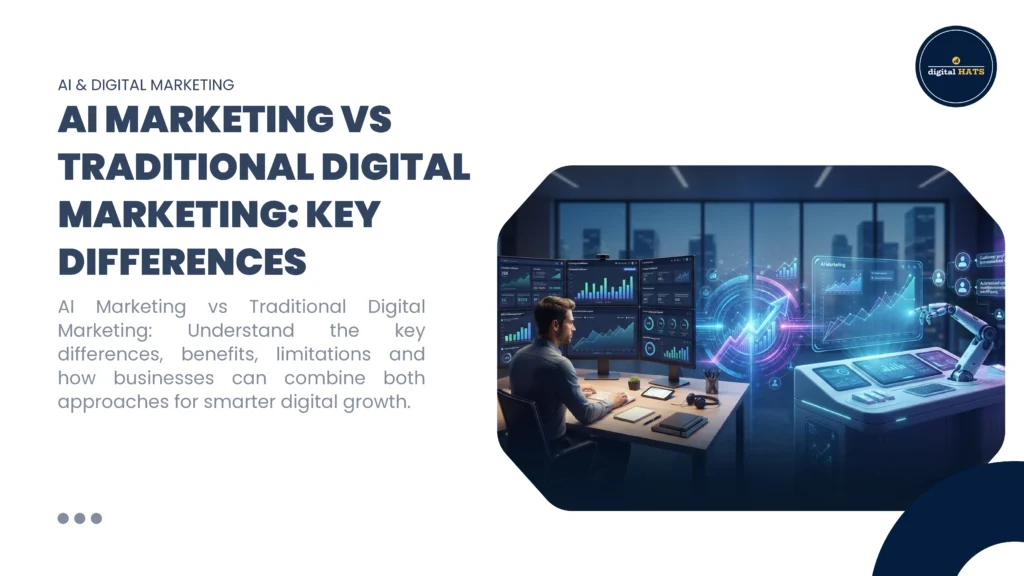
AI Marketing vs Traditional Digital Marketing: Key Differences
The main difference between using AI in marketing and traditional digital marketing will be the way you research, plan, execute and optimise your marketing.
Traditional digital marketing approaches will often be manually driven. Using AI means you have smart tools to help you with repetitive tasks, larger volumes of data and quicker decision making.
Below is an example of how this may differ –
Comparison Factor | Traditional Digital Marketing | AI Marketing |
Research | Often relies on manual research and analysis | Uses AI to analyse information and identify patterns |
Content creation | Primarily human-led writing and creative development | AI-assisted research, drafting, editing and content workflows |
Audience targeting | Uses platform targeting and manually defined segments | Can use AI-assisted behavioural analysis and predictive insights |
Personalisation | Often based on predefined customer segments | Can support more dynamic and context-aware personalisation |
Campaign management | Requires regular manual monitoring and adjustments | Can automate selected monitoring and optimization tasks |
Data analysis | Marketers analyse reports and performance manually | AI can process data and highlight patterns or anomalies |
Customer support | Often handled through human representatives and predefined workflows | Can include AI-powered chatbots and automated assistance |
Automation | Uses scheduled campaigns and rule-based workflows | Can include AI-assisted decisions and more adaptive workflows |
Scalability | May require additional manual effort as activity grows | Can help teams manage larger workloads more efficiently |
Human involvement | Human-led planning and execution | Human-led strategy supported by AI-assisted execution |
AI isn’t necessarily a better option to use. If an activity requires human judgement, creative input, sensitive communication or a clear relationship with the customer – then traditional methods may be more suitable.
Depending on what activity you’re doing and what outcome you want to achieve will determine which method would be best.
How AI Is Transforming Traditional Digital Marketing Channels
Whilst AI isn’t creating a completely new marketing environment, one of its most impactful uses is optimising digital marketing channels.
Some examples of this include;
1. SEO and AI-Powered Search Optimization
Traditional SEO requires keyword research, technical optimisation, content creation, internal linking and building authority.
AI can be used to help marketers with their research by providing useful insights around search terms, related topics, search intent and content opportunities.
By using an AI supported research tool, you can really understand what your customers are asking before they choose a service provider. This can then be used to create new blog topics, improve your service pages or create clusters of content.
AI has also changed how we search for information with summaries and chat bot like responses from AI.
This means it is more important to create helpful content to answer questions and demonstrate your knowledge.
Many modern search strategies will involve traditional SEO alongside Answer Engine Optimisation and Generative Engine Optimisation.
AI SEO services provided by DigitalHats can help by focusing on technical SEO, content strategy, search intent, entity optimisation and AI search.
AI can help with SEO but you still need a solid SEO strategy and useful, original content.
2. Paid Advertising and AI-Assisted Campaign Optimization
Traditional paid advertising requires selection of your target audience, keyword research, ad creation, budget and monitoring.
AI can provide additional features to help marketers with their campaign. By analysing your data, you can try different variations of your creative, understand trends and optimise the settings within your selected campaign.
Ads platforms now use machine learning technology which can help with things like bidding, audience signals and ad serving.
Using AI tools you can –
- Create different variations of your ad copy.
- Analyse search terms.
- Understand what segments of your campaign aren’t performing well.
- Discover what your audience is interested in.
- Review your landing page messaging.
- Get a summary of your reports.
- Come up with ideas for A/B testing.
However – AI can’t fully understand what your business goals are and cannot guarantee profitable campaigns.
You still need your human marketers to select the correct audience, ensure leads are quality, understand the economics of your campaign and decide how much to spend.
For businesses looking to combine established advertising expertise with smarter campaign management, DigitalHats’ PPC marketing services cover paid campaign strategy, targeting, creative development, testing and ongoing optimization.
3. Social Media Marketing and Intelligent Content Planning
Traditional social media requires content planning, caption writing, creative design, scheduling & interaction.
AI can help with many of the tasks involved;
By using AI – you can get ideas for content, understand your audience engagement, create variations of your captions and repurpose content.
AI can also help with social listening by identifying frequently asked questions from your audience.
However – social media is still very much people orientated. You need to have a brand voice, relevant content, creative ideas and engage with your audience. If you are using a high volume of AI generated content without a clear strategy in place your brand could come across as repetitive.
AI should help your social media team to become more efficient.
4. Email Marketing and Personalisation
Traditional email marketing often requires manual segmentation of your subscribers, regular newsletters and set follow ups.
AI can help to create more personalised emails by analysing customer behaviour.
An online store could use customer activity to recommend relevant products or identify follow up opportunities.
Using AI you can –
- Create variations of your subject line.
- Segment your audience.
- Get suggestions for your content.
- Analyse when to send your emails.
- Automate your customer journey.
- Follow up based on behaviour.
- Analyse your campaign.
However – personalisation should always be relevant and respectful. Be responsible with the data you have and ensure you are following any privacy and consent rules.
5. Content Marketing and AI-Assisted Content Creation
Traditional content marketing requires human research, planning, writing, editing and publishing.
Using AI tools can speed up the process. By using AI you can –
- Get ideas for content.
- Research questions your audience may have.
- Come up with an outline for your article.
- Group your topics.
- Identify gaps in content.
- Get suggestions for headlines.
- Get a summary of your research.
- Repurpose content.
However – AI generated content can sometimes be incorrect, repetitive and not original. Every article should have a clear purpose, accurate information, relevant examples and the correct human review.
Focus on creating content that shows your expertise and answers real customer questions.
Real-World Examples: How AI Marketing and Traditional Marketing Work Together
The differences become easier to understand when we look at – how businesses can use both approaches.
Example 1: Real Estate Business
A real estate company wants to create new leads for a new housing development.
Traditional digital marketing could consist of –
- Creating a landing page.
- Google and Meta campaign.
- Content creation.
- Localised web pages.
- Sales funnel.
AI can help with –
- Analysing the campaign.
- Seeing patterns in the data.
- Helping create variations for your ads.
- Automating the lead funnel.
- Chatbots.
- Summarising customer feedback.
This can help make the marketing team more efficient – but also keep the sales funnel focused on real customer requirements.
Example 2: Healthcare Clinic
A health clinic wants to raise awareness of their services and create new appointments.
Traditional marketing could be using SEO, local search, content creation and paid campaigns.
AI can help with researching content, appointment funnel, analysing performance and answering general questions.
However – providing medical advice, diagnosis and handling sensitive situations should be handled by the correct professionals.
Example 3: Education and Coaching Institute
An education institute wants to increase admissions.
Traditional marketing could be search advertising, social media, course pages, informative articles and email.
AI can help analyse what your audience is interested in, create content ideas, organise leads and personalise communication based on the relevant information.
It is important to have human counsellors to understand the students needs, discuss suitability of courses and make decisions about admissions.
Example 4: Restaurant or Food Business
A restaurant wants to increase orders and return customers.
Traditional marketing could be creating content on social media, local search, paid promotions and emails.
AI can help analyse your campaigns, plan content, summarise customer feedback and provide suggestions for promotions.
However – you will need to ensure that the food quality, customer service and authentic brand identity are maintained.
Overall you can see a pattern with these examples. Traditional marketing will provide the channels and strategy – whilst AI can help improve specific areas.
Benefits of AI Marketing
There are a number of benefits for using AI marketing.
1. Faster Marketing Workflows
Using AI helps reduce tasks such as summarising research, outlining content, creating reports and analysing data.
This means your marketing team have more time to focus on strategy, creativity & customer experience.
2. Better Use of Marketing Data
Companies gather data from their website, advertising platforms, CRM and customer interactions.
Using AI can help you find patterns in this data and see where you can improve.
3. More Relevant Customer Experiences
Using AI can help you personalise your offering to your customers by using the data you have on them to suggest content, products, services etc. that would be relevant.
If used responsibly – it can help provide a more useful experience for customers.
4. Improved Marketing Automation
Using AI powered processes can help you automate tasks such as categorising leads, reminding you to follow up, content processes and reports.
This can save you time & ensure consistency across your team.
5. Greater Operational Efficiency
Marketing teams can use AI to help them with research, planning and implementation without having to do everything manually.
How efficient it is will depend on the tools, processes & quality checks you have in place.
Limitations and Challenges of AI Marketing
There are some limitations of using AI within marketing.
1. AI Can Produce Inaccurate Information
AI can produce factual errors, incorrect advice and inaccurate information.
Ensure that any content, reports and campaign advice provided by AI is reviewed to ensure it doesn’t cause any critical issues.
2. AI Does Not Understand Every Business Context
Whilst you’re using an AI tool to analyse the patterns within your data, it may not understand everything about your business, such as its position in the market, relationships with customers, business goals and brand values.
You will still need humans to understand the information and determine what makes most sense for your business.
3. Over-Automation Can Damage Customer Experience
Some situations may not be best to automate.
Customers may need to interact with a real person if there are complicated complaints, personal information, expensive purchases or require personal guidance.
4. Data Privacy and Security Matter
Using AI within marketing usually incorporates customer data, behaviour data and business data.
Companies must have correct data handling processes, security and consent measures in place. Ensure you know how the tools you’re using store and use information.
5. AI Tools Do Not Guarantee Marketing Results
Purchasing a subscription does not guarantee improvements to your rankings, sales and lower cost per acquisition.
It depends on how you’ve set up your strategy, how well you’ve implemented it, the quality of data, customer experience and your business model.
Can AI Replace Traditional Digital Marketing?
No. While there are many changes that AI can bring to digital marketing, you will still need traditional marketing methods and human knowledge.
SEO, advertising, social media, email marketing, content and website design will still be needed.
Yes, AI can help optimise each part however it will not completely replace your marketing strategy.
For example –
- While AI can come up with ideas for content – ultimately a marketer will need to decide if it fits with the brand.
- While AI can analyse the data from the advertising – ultimately a strategist will need to look at if the campaign is creating quality leads.
- While AI can write emails for you – it is best to have a human eye on key communications with customers.
- While AI can highlight search trends – an SEO expert will need to create a strategy based on search intent and business goals.
- While AI can create automated responses – some complex scenarios with customers may still need human interaction.
The future will not be humans vs AI.
Instead it is humans with intelligent technology to support their knowledge.
AI Marketing vs Traditional Digital Marketing: Which Is Better for Small Businesses?
Small business owners don’t need to use any one method.
Traditional digital marketing can be used so you have the core channels to get your customers to learn about your business. The use of AI can help to make some tasks more efficient to avoid needing a large marketing team.
Small businesses can use –
- Create an easy to search website and service pages.
- Improve your SEO so you show up for searches customers are doing.
- Pay to target certain customers using paid ads.
- Research content and questions your customers have using AI.
- Automate any appropriate emails and enquires.
- Use data to understand where you can improve.
The key is to use AI to solve any real problems.
It is not advisable to buy many different tools just because AI marketing is becoming popular. Start with the areas of marketing that are taking the most time or have the most impact on gaining new customers.
How Businesses Can Combine AI Marketing and Traditional Digital Marketing in 2027
For 2027 it would be best to create an integrated marketing system.
Here’s how you can do this.
Step 1: Establish a Strong Digital Marketing Foundation
You need to make sure you have the essentials –
- A professional mobile-friendly website.
- Clear information about your services and products.
- SEO optimised.
- Social profiles.
- Paid ads.
- Landing pages focused on conversion.
- Metrics.
You will not be able to make up for a confusing website, unclear offer or poor customer experience with AI.
Step 2: Identify Where AI Can Improve Efficiency
Look at what tasks you carry out with your current marketing strategy and see if there are any that can be automated.
Examples include –
- Content research.
- Creating marketing reports.
- Organising leads.
- Drafting content.
- Analysing campaign performance.
- Handling regular customer queries.
Select the right tools for each issue.
Step 3: Introduce Marketing Automation
Bring together the right tools to automate certain tasks.
For example, when a prospective customer fills in a query form, the business can automatically capture this information in their CRM, alert the relevant person and set up appropriate follow up.
AI can help you sort leads and suggest what to say but important conversations and sales should be handled by staff.
Step 4: Strengthen Your SEO and AI Search Strategy
Keep investing in your SEO strategy but also ensure your site is set up for evolving search behaviours.
This can be done by making sure your content is high quality, answering customer queries, creating topic clusters, linking internally and providing good brand information.
Ensure that wherever relevant you are using AEO and GEO within your overall strategy.
Step 5: Keep Human Oversight in Important Decisions
Decide what tasks you want to automate and which ones need manual approval.
For example, you may want to use AI to create a campaign report but have a marketing strategist look over the information before adjusting your budget.
You may want to create a draft article with AI but have an editor review to ensure it is accurate, unique, brand specific and useful.
Step 6: Measure Business Performance
Don’t just measure how many things you’re automating and how much content you’re producing.
Look at what is really happening such as –
- Qualified leads.
- Conversions on your website.
- Cost per acquisition.
- Return on ad spend.
- Organic search performance.
- Conversion from leads to sales.
- Customer engagement.
- Time saved on marketing.
- Revenue generated.
The aim is to improve the performance of your business using technology.
What Skills Will Digital Marketers Need in the AI Era?
As AI becomes more prominent in digital marketing roles, digital marketers will have to adapt.
They will require a broader skillset including;
Marketing Strategy – This is knowing how to utilise your business goals, customer behaviour, position within the market and understanding the whole customer journey.
AI Knowledge – Knowing how different AI tools work, when to apply them and when they will not be as effective.
Data Analysis – Knowing how to interpret data to make informed decisions.
Search/SEO and AI – Knowing about organic search, search intent, AEO, GEO and being able to make content searchable.
Content Assessment – Knowing if the content you’re using is correct, useful, original and fits with your brand positioning.
Automation – Knowing how to implement tools and automate processes to improve efficiency but still having the right controls.
Understand Customers – Marketing is ultimately about people.
The value of a digital marketer will rely more on their ability to use technology with good judgment and business knowledge.
The Future of Marketing: AI-Powered, Human-Led and Business-Focused
AI marketing provides new ways for businesses to plan and execute their digital marketing. It can provide benefits by improving research, helping with personalisation, reducing time spent on mundane tasks and making marketing data easier to analyse.
But traditional digital marketing will still play an essential role.
The best way to utilise AI marketing is by building on traditional marketing techniques with the right tools.
We see this as the next step of digital marketing growth. By combining SEO, Paid Ads, Social Media, Content Strategy, AI automation and visibility in search to create an integrated approach.
This will help you target your audience more effectively, gain their trust, create quality opportunities and get more from your marketing spend.
Looking to improve your current marketing strategy with AI?
Explore DigitalHats’ digital marketing services and discover how traditional marketing expertise and AI-powered capabilities can work together to support your business growth.
Frequently Asked Questions About AI Marketing vs Traditional Digital Marketing
Traditional digital marketing involves using traditional marketing online techniques like SEO, PPC, Social Media, Email and Content Marketing. AI Marketing is using artificial intelligence to help improve and enhance these areas. Through data analysis, automation, personalisation, content help and prediction. AI Marketing can be used alongside traditional digital marketing.
Neither are better than each other. Traditional digital marketing offers a tried and tested method of reaching your customers however AI can speed up certain aspects of marketing and make them more automated and data driven. Most businesses will benefit from a mixture of both depending on their goals, budget and resources.
While AI can be used to automate or support some of these marketing activities, it cannot replace the strategic, knowledgeable, creative and communicative elements of marketing provided by experienced marketing professionals. Businesses will still require specialist marketing professionals to make strategic decisions, analyse results, manage customer experiences and make strategic decisions.
This could be using AI to help research content, automate email personalization, use predictive analytics with customers, an AI chatbot, optimise advertising, segment customers better, provide reports on campaigns and automate marketing processes. This can improve certain areas of marketing for businesses.
Yes! Whilst AI will change how businesses manage their SEO, Paid Advertising, Social Media Marketing, Email Marketing and Content Marketing, it still needs to be done with a clear marketing strategy and an effective way to communicate with customers.
AI can assist SEO teams with keyword and search intent research, topic clustering, content gap analysis, data interpretation, content planning and internal linking opportunities. It can also support workflows related to AI-powered search visibility. However – technical SEO, useful content, quality control & human expertise remain essential.
Yes – many AI tools have different pricing models. You can start off using only a few tools which will help you with your specific issues. Start by identifying where you are doing repetitive or time consuming tasks in your marketing and see if you can use AI to improve them in a cost-effective way.
Not necessarily. Google determines the value of your content by looking at how useful, relevant, high quality it is and so on. Whilst AI can help you create content, it should still provide accurate, original and valuable information whilst providing a great experience for your audience.
AI marketing can produce inaccurate information, overlook business context, create generic content and introduce data privacy or security risks. Excessive automation can also weaken customer experiences. Human review, appropriate data practices and clear business objectives are important when implementing AI.
A practical strategy combines established digital marketing channels with carefully selected AI tools. Businesses should maintain strong SEO, use paid advertising where appropriate, develop useful content, improve customer communication, automate repetitive workflows and measure performance against business outcomes.
Marketing automation uses predefined rules and workflows to perform repetitive tasks, such as sending scheduled emails or assigning leads. AI marketing can go further by analysing data, identifying patterns, generating recommendations and supporting decisions. The two can work together, but automation does not always require AI.
AI is likely to change the tasks digital marketing professionals perform rather than eliminate the need for expertise. Marketers will increasingly use AI for research, analysis and execution while focusing on strategy, creative direction, customer understanding, quality control and business results.
Final Takeaway
AI marketing should not be considered a separate activity to traditional digital marketing.
Traditional digital marketing is essential for building up your channels, gaining knowledge about your customers and providing a solid strategy. However, using AI can help improve your research, personalisation, automation and analytics.
Those who truly understand how to use both strategies will be best placed for the future.
Using AI can help make your marketing more intelligent however, without strategy, creativity, trust and knowledge you won’t have a meaningful marketing strategy.