How to Choose a Digital Marketing Agency in India: 15 Questions Every Business Must Ask
India has thousands of agencies offering –– SEO, social media, paid advertising, website development, branding and performance marketing services. On paper – many agencies look remarkably similar. Their websites mention growth, ROI, transparency and results. Their portfolios showcase attractive creatives and impressive claims.
Yet, business owners frequently change agencies every 12 to 18 months.
Why?
In most cases –– businesses do not hire the wrong agency because of poor intentions. They hire the wrong agency because they ask the wrong questions during the evaluation stage.
Many companies compare agencies only on cost. Others select agencies based solely on referrals. Some choose the agency with the most polished presentation.
Unfortunately, digital marketing partnerships rarely succeed because of presentations alone.
The “right agency” should understand your business, align with your goals, communicate clearly and build a long-term growth strategy.
If you are planning to hire a Digital Marketing Agency in India –– the following questions can help you make a more informed decision.
Question 1: Do They Understand Your Industry?
Every industry behaves differently online.
An educational institution attracts and nurtures leads differently from a healthcare clinic. A real estate company has a different customer journey compared to an e-commerce brand.
Before finalizing an agency, ask –
- Have you worked with businesses similar to mine?
- What challenges are common in my industry?
- How would you approach marketing for my business?
Agencies that understand industry nuances often require –– less onboarding time and develop more relevant strategies.
For example, at digitalHats, our experience working with educational brands such as LearnifyU has shown that parents do not make decisions immediately. They often research, compare programs, and evaluate credibility over several weeks. Marketing strategies must reflect this behaviour.
Question 2: Can They Show Real Case Studies Instead of Generic Claims?
Many agencies mention “successful campaigns” –but fail to provide specifics.
Ask for:
- Case studies
- Before-and-after results
- Growth timelines
- Traffic improvements
- Lead generation examples
Look beyond vanity metrics.
An increase in followers means little if inquiries remain unchanged.
The best agencies openly discuss both successes and lessons learned.
Question 3: How Do They Define Success?
Different businesses define success differently.
For some businesses:
- More leads matter most.
For others:
- Brand awareness
- Online visibility
- Lower acquisition costs
- Website traffic
- Local search visibility
Ask:
“What KPIs would you track for our business?”
If every prospect receives the same answer –– the agency may be using standardized strategies rather than customized planning.
Question 4: Who Will Actually Work on Your Account?
This question is frequently overlooked.
In many cases, business owners meet senior strategists during sales discussions but later communicate only with junior executives.
Clarify:
- Who will manage the account?
- Will there be a dedicated point of contact?
- How often can we speak with strategists?
A strong working relationship often matters as much as – technical expertise.
Question 5: Which Services Are Managed In-House?
Some agencies outsource significant portions of their work.
There is nothing inherently wrong with outsourcing, –but transparency is important.
Ask:
- Is content created internally?
- Is SEO performed internally?
- Who develops websites?
- Are ad campaigns managed by your own team?
Businesses seeking integrated support often prefer agencies capable of handling multiple functions under one roof.
For instance, companies working with a full-service Digital Marketing Agency in India often benefit from –– coordinated SEO, social media, and website strategies.
Question 6: How Will They Learn About Your Business?
A surprising number of agencies begin execution without detailed discovery sessions.
Effective onboarding typically includes:
- Business goals discussion
- Competitor analysis
- Audience profiling
- Current marketing assessment
- Historical performance review
If an agency proposes a strategy before understanding your business –– caution is advisable.
Question 7: What Is Their SEO Philosophy?
Search engine optimization remains one of the most “sustainable” customer acquisition channels.
However, SEO approaches vary significantly.
Ask:
- How do you conduct keyword research?
- How do you approach content strategy?
- How do you earn backlinks?
- How do you measure SEO success?
Businesses evaluating SEO support should also review whether the agency offers –– dedicated SEO Services in India rather than treating SEO as an add-on service.
A strong SEO program combines –– technical improvements, content development, user experience, and long-term authority building.
Question 8: How Do They Approach Content Creation?
Content influences:
- Rankings
- Brand positioning
- Conversion rates
- Customer trust
Ask agencies:
- Who writes the content?
- Is content customized?
- How do you ensure originality?
- How is expertise incorporated?
Businesses increasingly need content that demonstrates real-world understanding rather than –– generic information.
The strongest agencies create content informed by actual client experiences, customer conversations, and market observations.
Question 9: How Frequently Will Communication Happen?
Lack of communication is one of the most common reasons – businesses leave agencies.
Establish expectations early.
Questions to ask:
- How often are review meetings scheduled?
- Will we receive monthly reports?
- What communication channels will be used?
- How quickly do you respond to queries?
Regular communication prevents –– misunderstandings and strengthens long term collaboration.
Question 10: What Tools and Reporting Systems Do They Use?
Professional agencies rely on tools for research, tracking and reporting.
Ask about:
- Analytics platforms
- SEO tools
- Advertising dashboards
- Reporting systems
More importantly, ask:
“Will you explain the reports in business language?”
Data becomes valuable only when translated into actionable decisions.
Question 11: How Do They Handle Website Performance?
Marketing campaigns often fail because websites are unable to convert visitors effectively.
Ask:
- Will you review our website experience?
- Can you recommend improvements?
- Do you provide website design support?
Many businesses discover that improving website experience significantly improves campaign performance.
If website improvements are required –– partnering with a Website Design Company in India that understands conversion focused design can strengthen overall marketing outcomes.
Question 12: How Do They Integrate Social Media With Broader Marketing Efforts?
Social media should not operate in isolation.
Ask:
- How does social media support lead generation?
- How will campaigns support SEO and website traffic?
- How do you measure engagement quality?
Businesses seeking comprehensive growth often combine SEO with support from a Social Media Marketing Agency in India to build both ––visibility and engagement.
Integrated marketing generally produces stronger long term results than disconnected campaigns.
Question 13: What Is Included in the Pricing?
Pricing comparisons become difficult when deliverables are unclear.
Request detailed information regarding:
- Number of deliverables
- Reporting frequency
- Ad management scope
- Revision policies
- Additional charges
The least expensive proposal is not always the most economical.
Low-cost retainers often result in limited strategy, reduced communication, or inconsistent execution.
Question 14: How Long Should Results Take?
Be cautious of unrealistic promises.
Examples include:
- Guaranteed first page rankings in 30 days
- Instant lead generation
- Guaranteed viral campaigns
Sustainable digital growth usually requires patience.
SEO often requires several months. Social media communities develop gradually. Paid campaigns improve through continuous optimization.
Reliable agencies set realistic expectations.
Question 15: Why Should You Trust This Agency With Your Brand?
This final question combines all previous questions.
Evaluate:
- Transparency
- Responsiveness
- Strategic thinking
- Case studies
- Communication quality
- Cultural fit
Remember that your agency represents your brand online.
The ideal partnership feels collaborative rather than transactional.
Five Red Flags Businesses Should Watch For
1️⃣ Guaranteed Rankings
No agency controls search engine algorithms. Absolute guarantees should raise concerns.
2️⃣ Extremely Low Pricing
Unusually low pricing often limits strategy, quality, or execution.
3️⃣ No Clear Reporting Structure
Businesses should always understand what is being done and why.
4️⃣ One Size Fits All Proposals
Every business has unique objectives. Generic proposals may indicate generic execution.
5️⃣ No Questions About Your Business
Agencies that ask very few questions during the sales process may not invest sufficient effort in strategy.
A Simple Agency Evaluation Scorecard
Score each shortlisted agency out of 10.
| Evaluation Area | Score (/10) |
|---|---|
|
1. Industry Understanding |
– |
|
2. Communication |
– |
|
3. Reporting Transparency |
– |
|
4. Strategic Thinking |
– |
|
5. Case Studies |
– |
|
6. Website Expertise |
– |
|
7. SEO Knowledge |
– |
|
8. Pricing Clarity |
– |
|
9. Responsiveness |
– |
|
10. Overall Fit |
– |
The agency with the highest score may not always be the cheapest, –but it is often the best long-term partner.
Putting It All Together
Choosing a digital marketing agency is not simply –– a vendor selection exercise.
It is a growth decision.
Businesses that spend “additional time” evaluating agencies often build –– stronger partnerships, avoid unnecessary agency changes & achieve better marketing outcomes.
Instead of asking, “Which agency is cheapest?” consider asking:
“Which agency understands –– where our business wants to go and has a clear plan to help us get there?”
The answer to that question usually leads –– to the right decision.
❓FAQs
1. How do I choose the best digital marketing agency in India?
Evaluate agencies based on –– industry understanding, communication, case studies, reporting transparency and strategic approach rather than “cost” alone.
2. What questions should I ask before hiring a digital marketing agency?
Ask about –– experience, reporting, pricing, communication, case studies, timelines and how success will be measured.
3. How much does hiring a digital marketing agency in India cost?
Pricing varies depending on –– services, business goals, competition and campaign scope.
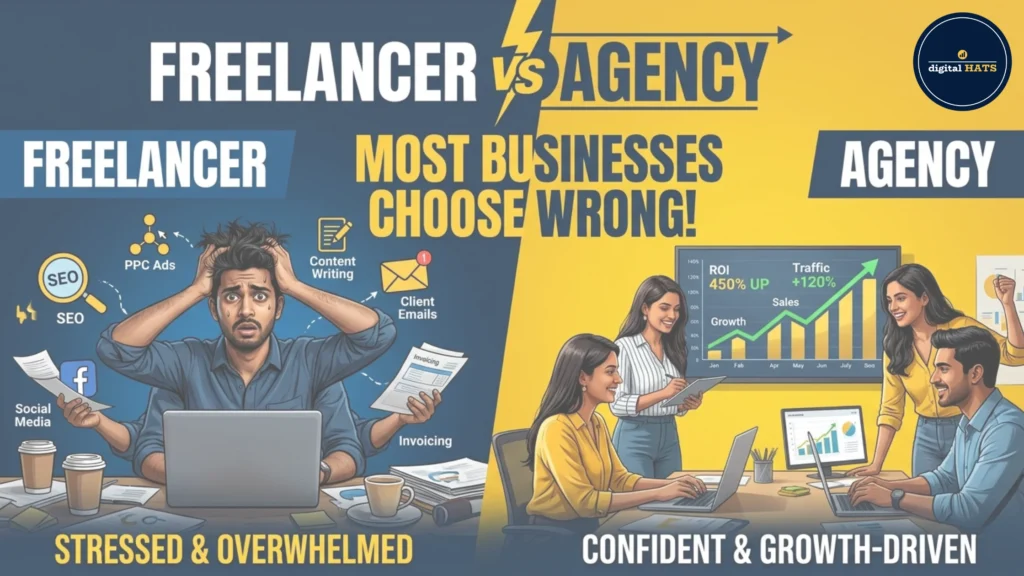
4. Should I hire a freelancer or an agency?
Freelancers may suit smaller projects –– while agencies typically provide broader expertise & integrated support.
5. How long should I work with a digital marketing agency before evaluating results?
Timelines vary by channel, –but most businesses should evaluate partnerships over several months rather than a few weeks.
People Also Ask
What makes a good digital marketing agency?
A good agency combines –– strategic thinking, transparent communication, measurable reporting and industry understanding.
How many agencies should I compare before hiring?
Comparing three to five agencies generally provides enough perspective for informed “decision-making”.
Is it better to hire a local agency or a national agency?
The answer depends on your objectives. Local agencies may understand regional markets ––while national agencies may provide broader expertise.
Should businesses choose agencies based only on price?
No. Businesses should evaluate –– expertise, communication, deliverables and long-term value alongside pricing.
What is the biggest mistake businesses make while hiring an agency?
Selecting an agency solely because –– it offers the lowest cost is one of the most common mistakes.