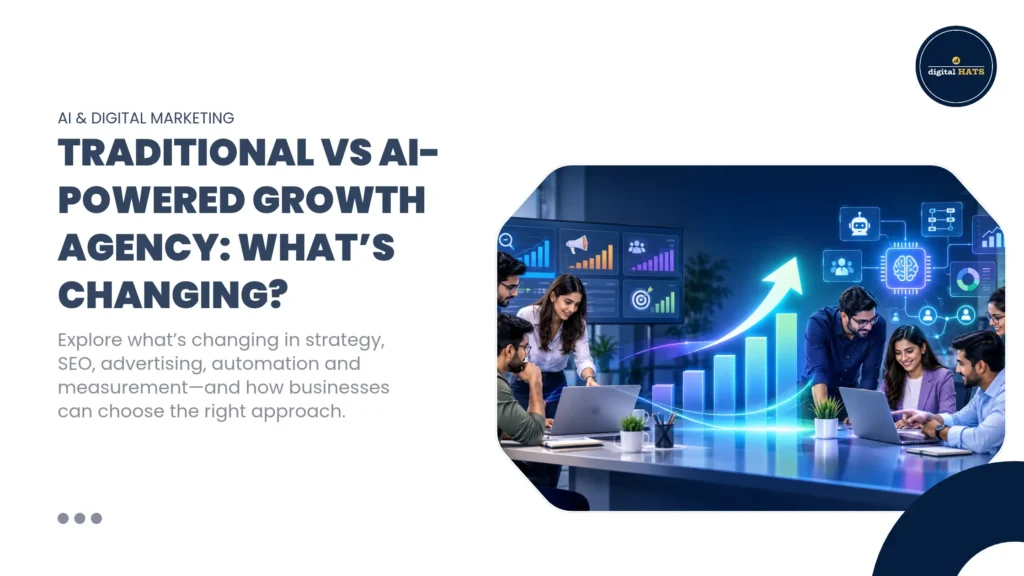
Traditional Digital Marketing Agency vs AI-Powered Growth Agency: What’s Changing?
Traditional digital marketing agencies help improve brand awareness, attract new prospects and increase leads through SEO, paid marketing, social media and content marketing.
However, it is now about how these services are integrated, strategized, measured and optimised.
AI growth agencies leverage many of the same digital marketing tools but enhance their value with data-driven insights (through AI), automation, integrated data and placing more of a focus on the customer journey. Overall the aim is to help businesses make better decisions in their marketing strategies meaning that marketing will contribute more to growth.
If selecting an agency to work with, it is less about whether traditional techniques are obsolete, and more about – whether the agency can link marketing activity to business outcomes. In addition, it is key to ensure that the agency can adapt to changes in customer and technological trends.
What is a traditional digital marketing agency?
Traditional digital marketing services may include:
- Search Engine Optimisation (SEO)
- PPC/ Paid Social campaigns
- Social Media Management
- Content Marketing
- Web Design and development
- Email Marketing
- Analytics and campaign reporting
Provided with a good strategy, good delivery and proper measurement, these can be very effective.
However, within a traditional model – activities may be broken down into separate channels. Therefore, you may have separate teams managing the SEO, PPC/ Paid Social Campaigns and Social Media. Within this set up – performance may be reported separately within each channel. This can make it difficult to understand the impact of marketing across different channels in relation to one another.
This isn’t necessarily a bad thing. It can be beneficial to have specialists. However, in reality, people aren’t considering channels in isolation.
For example, a prospect may initially come across your brand via Search. They may visit the site, see something on social media, research other options and then come back after seeing an advert (PPC) and make an enquiry. If the agency measures each activity in isolation, it may miss how those interactions work together.
What is an AI-powered growth agency?
Combination of marketing knowledge with AI, automation and integration.
Tasks can be made efficient by using AI to identify trends from data, understand what questions customers may have, create adaptable content, summarise performance, and allow teams to experiment efficiently.
Automations can improve efficiency by reducing repeated tasks including passing on leads between systems, initiating follow ups, and generating regular reports.
Growth focused agencies aren’t defined by simply having the right technologies. It is how they are used that makes a growth focussed agency.
While AI can be used in many ways, people should still be involved in making strategic decisions, creative decisions, understanding customers, quality assurance and overall decision making. This means that AI should be considered as a tool within the process, but people should be maintaining the knowledge and responsibility.
At DigitalHats – this means connecting digital visibility, customer acquisition, marketing systems and measurement rather than treating every channel as a separate activity.
Traditional agency vs AI-powered growth agency
Area | Traditional digital marketing agency | AI-powered growth agency |
Planning | Often organised around channels and campaign plans | Connects channels to customer journeys and business goals |
Research | Uses keyword research, audience data and competitor analysis | Uses those foundations alongside AI-assisted analysis and synthesis |
Content | Plans and produces content through established workflows | Uses AI to support research and production, with human editing and review |
Campaign optimisation | Relies on platform tools, reporting and specialist analysis | Combines platform data with automation and AI-assisted insights |
Lead management | May focus on generating enquiries | Also considers lead routing, follow-up, qualification and conversion |
Measurement | May report channel-level metrics | Connects channel performance with lead quality and business outcomes where data allows |
Workflow | May depend on manual coordination between teams | Uses connected systems and automation to reduce repetitive work |
Human role | Strategy, execution and optimisation | Strategy, judgement, oversight and decisions—supported by AI and automation |
This is not a clear distinction. Agencies claiming to be AI powered may not yet be using advanced automation and AI technologies – whilst traditional agencies may have disconnected channels. It is important to understand what process is being implemented by the business.
What is changing in digital marketing?
1. From channel activity to connected growth
Lead generation campaigns may result in low quality leads, and high levels of traffic to a website may not result in clear actions from users. Or, submissions may be made but are difficult to turn into sales.
Growth orientated thinking looks at how Marketing is contributing to the entire journey from awareness to lead, engagement and conversions.
This doesn’t necessarily mean that an agency will be responsible for managing the entire sales process.
However – they should understand what the business goal is, work out the right metrics to measure success with, and know which parts of Marketing are reliant on subsequent actions.
2. From producing more content to answering real customer questions
Content creation can be aided by AI, but content volume may not be the best way to grow.
Content for your business should be knowledgeable, answer questions and help people make decisions. It should also be accurate, unique and useful.
Whether for traditional searches or AI-based searches, it is important to have a good content base in place. This includes technical SEO, valuable content and informative content for businesses. DigitalHats explains these foundations through its AI SEO services and Generative Engine Optimization services pages.
3. From search rankings alone to broader discovery
Search engines remain an important way for people to discover businesses. At the same time – customers may use conversational AI tools to research options, compare services or ask for recommendations.
Consider positioning your expertise, products/services and brand well on your websites and trusted sources. There is no guarantee that you will be listed in any AI platforms, however – this can depend on which platform, query, content available and how it is answered.
Using techniques – such as Answer Engine Optimisation (AEO) and Generative Engine Optimisation (GEO), businesses can ensure they are creating valuable answers and improving visibility. AEO should be used to support, not replace – good SEO and marketing practice. Find out more about Answer Engine Optimisation and how it can support wider visibility.
4. From manual reporting to more useful measurement
Dashboard metrics can be useful in giving an overview of how campaigns are performing, however you may not gain full insight into whether the right audience is being targeted.
Measuring metrics in line with business objectives (quality leads, conversion rates, cost per quality lead, sales opportunities/revenue if trackable) will give a better indication.
Even with AI, if you have inaccurate data tracking, incomplete CRM data or an unclear definition of a quality lead, you won’t be able to gain better insights. Starting with clear objectives and accurate data will allow better measurement.
5. From generating leads to supporting the next step
Lead generation is only one part of growth. If enquiries are not followed up promptly, assigned correctly or tracked through the sales process – marketing performance can look better than the business results.
Automation can help with routine tasks – such as lead routing, reminders, email sequences and reporting. But the workflow should be designed around the customer experience, with clear ownership & appropriate human involvement.
For example, a business might automate an initial acknowledgement – while keeping a person responsible for answering complex questions or handling high value opportunities.
What AI should—and should not—do
AI can be useful for:
- Find customer insights
- Create content structures and content, and re-purpose content
- Gain summary insights from campaigns, highlighting areas to explore
- Improve team efficiency in generating variants of a campaign
- Automate repetitive / formulaic processes
- Supporting segmentation and personalisation when the underlying data is appropriate
It should not be treated as a substitute for:
- Strategic business decisions.
- First-hand customer understanding
- Content accuracy and content judgment.
- Creativity and brand decisions.
- Data privacy, user consent, and data security.
- Accountability within decision making of campaigns.
Where possible, use AI judiciously. Only use in places where it is improving speed, uniformity or insight. Consider if improvements are significant.
How should a business choose the right agency model?
Consider your requirements, resources and growth within your business.
Traditional specialist agencies
If you require specific knowledge within one channel, have a clear strategy and can manage the wider marketing processes internally, then a traditional specialist agency may be right for you.
Growth driven AI agencies
If you want to integrate multiple marketing channels, better insights, reduce repetition and fix issues with handing leads into follow up, then an AI driven growth agency may be suitable.
Questions to ask:
- How will you align marketing with our business goals?
- What metrics will we measure? How will we measure them?
- Where will AI/automation be used within the service, and what will be manually reviewed?
- How do you ensure the quality of leads?
- How will you integrate with our sales or customer support processes?
- What will you need from us to make this strategy successful?
Be sure to get clarity on how the process will run, roles and reporting. Be cautious of any vague guarantees around ranking in search engines, or AI suggestions, or guarantees around a certain number of leads. Without clear understanding of your market, budget and conversion process – it is risky to guarantee these outputs.
The DigitalHats approach: marketing built around growth
DigitalHats brings together digital marketing, AI-assisted workflows & visibility strategy to help businesses make their marketing more connected and measurable.
That can include SEO, paid campaigns, content, social media, website improvements, AI search visibility and analytics – depending on the business’s needs. The objective is not to add every service or tool to every plan. It is to identify what is limiting growth and build a practical approach around it.
For some businesses – the priority may be improving organic visibility. For others, it may be generating qualified enquiries, improving landing pages or making better use of existing lead data. The right mix should follow the business problem, not a technology trend.
Explore DigitalHats’ digital marketing services to see how channel expertise can fit within a broader growth strategy.
Frequently asked questions
Not automatically. The better choice depends on – the business’s goals, the agency’s expertise and how well its process fits the company’s needs. AI can improve some workflows – but it does not guarantee better strategy or results.
Yes. SEO and paid advertising remain important marketing disciplines. An AI-powered growth agency – may use AI and automation to support research, analysis and optimisation, while relying on experienced specialists to guide strategy and execution.
AI is changing how some marketing tasks are performed – but businesses still need strategy, customer understanding, creative judgement and accountability. Agencies that use AI responsibly can support their teams and clients more effectively – the impact will vary by service and business.
AI marketing often refers to using AI for marketing tasks such as – content, targeting, analysis or automation. AI-powered growth is a broader operating approach that connects marketing activities with customer journeys, lead management and business outcomes.
It may be useful – if the business needs help connecting channels, improving workflows or measuring performance. A small business with one clear marketing need may be better served by a focused specialist. Start with the business problem and evaluate the proposed process.
No. There is no reliable guarantee that a business will be recommended or cited by a particular AI platform. Businesses can improve the clarity, usefulness and credibility of their online information – but visibility depends on the platform, query and available sources.
The real change is how marketing works together
Growth in your business through AI does not mean abandoning other marketing strategies. Instead – it means combining them more efficiently, and making them work better with insightful data and processes to increase growth.
AI can be used to improve how teams operate. However, make sure you are partnering with an agency who know your customers well, can explain clearly how they will help, and can demonstrate valuable results. They should also be appropriately balanced between technology and people.
DigitalHats offer digital growth in your business in the perfect balance between marketing knowledge, AI assistance, and demonstrable improvements, tailored to the needs of your business.