Will AI Replace Digital Marketing Agencies? What Businesses Should Expect
Artificial Intelligence is having an impact within marketing and can be used for many areas such as generating content, analysing data and managing client interaction. This means that these processes can be both accelerated and simplified by employing AI.
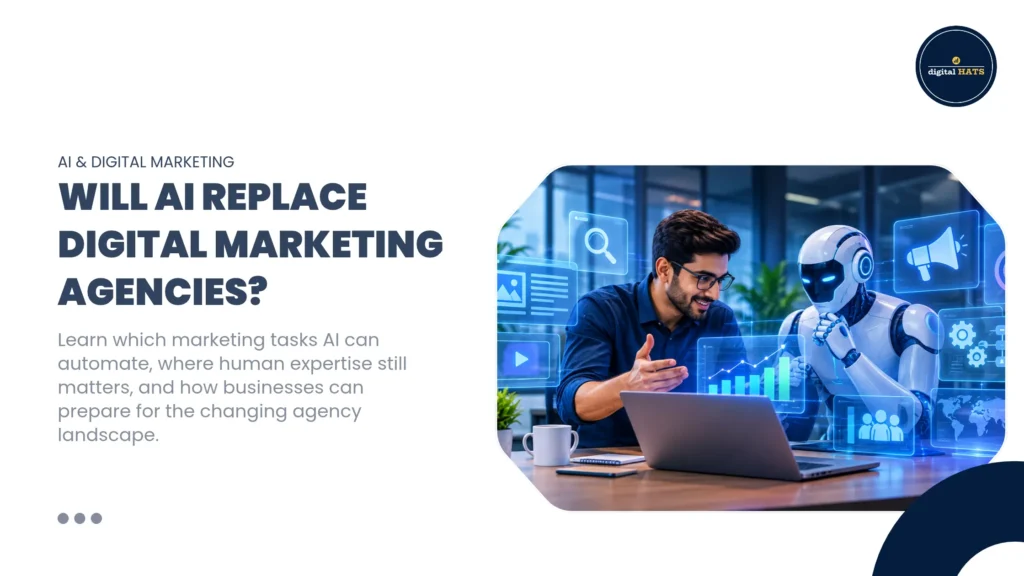
This raises an important question: Will AI replace digital marketing agencies?
Whilst AI is able to streamline processes and undertake research to inform better decisions, it cannot fully replace humans. People are still needed to provide specialist knowledge and innovative thinking and to both analyse and take responsibility for clients.
However, digital marketing agencies are set to evolve. Expect to see greater use of AI, along with a move towards marketing that is even more data informed and holistic.
How Is AI Changing Digital Marketing?
Artificial Intelligence is now being utilised within many areas of digital marketing. It can be used to help with processes, analyse consumer data and make marketing decisions.
Areas that can benefit include;
- Content creation – such as structuring, writing and generating material.
- SEO research – examining relevant keywords, search purpose and content.
- Paid advertising – analysing consumers and fine-tuning digital advertising.
- Social media – developing and analysing material.
- Marketing automation – controlling and re-peating processes and communications.
- Analytics – spotting trends and condensing results.
Whilst these tools can save time, there is still a need for human control and review.
Can AI Replace Digital Marketing Agencies Completely?
Whilst there are various functions that can be undertaken by AI, developing an efficient marketing strategy goes beyond technology.
An understanding of the market, consumers and competition, alongside knowledge of business goals must also be present.
For example, a firm may wish to introduce a new service. Although AI can assist with researching competition, devising content and reviewing advertising data, it cannot make strategic decisions about how best to market the service, identify suitable consumers and form an approach that engenders trust.
Furthermore, AI is unable to fully ‘own’ a firms marketing performance.
As a result, marketing agencies which utilise both technological and expert marketing knowledge are therefore likely to continue to be highly relevant.
What Marketing Tasks Can AI Replace or Automate?
AI is particularly useful for repetitive, structured and data-heavy activities.
1. Basic Content Production
AI can be used to develop content and for creating content structures, social media and email.
Unedited AI content may suffer from poor quality, incorrect data and duplication.
People are still needed to ensure that content is both accurate and fits the brand and is innovative.
2. Keyword and Competitor Research
AI can assist in developing keyword lists and researching question topics. It can also analyse rival content.
Whilst AI can carry out these processes, it is still important for an SEO expert to assess consumer search purpose, market competition, and relevance, as well as potential for the business.
For businesses investing in AI SEO services, the objective should be better research and strategy – not simply producing more pages.
3. Advertising Analysis
AI can be used to analyse advertising campaigns, analyse consumers and test advertising material.
Machine learning is also used within advertising for auctioning, targeting and ad serving.
Humans are still required to manage advertising campaigns, allocate budgets, determine how best to position products or services and assess the quality of leads.
4. Social Media Scheduling
AI can be used to devise, write and manage social media content.
Nevertheless, humans are still needed to analyse consumer opinion, manage responses to controversial posts and to foster genuine connections with consumers.
5. Reporting and Data Analysis
AI can collate and analyse reports and flag up anomalies.
Despite this, marketing experts need to analyse results and advise on suitable actions to take.
Greater click-through rates do not automatically equate to a business receiving improved lead quality or increasing sales.
What Marketing Work Still Needs Human Expertise?
Whilst AI can provide great tools to assist in many areas, there are still key areas where humans play a key role.
Marketing Area | Why Human Expertise Matters |
Business strategy | Understanding commercial goals and market positioning |
Brand development | Creating a distinctive identity and consistent messaging |
Creative direction | Developing ideas that connect with real audiences |
Customer understanding | Recognising emotions, objections and buying behaviour |
Content quality | Adding experience, accuracy and original insights |
Marketing decisions | Evaluating risks, budgets and business priorities |
Client relationships | Building trust, communication and accountability |
Although AI can generate recommendations, it is vital that individuals are available to question these and utilise their knowledge to then successfully decide on the best course of action.
How Digital Marketing Agencies Will Change in the AI Era
The traditional agency model is evolving. Businesses should expect agencies to focus less on isolated deliverables and more on connected marketing performance.
1. From Content Volume to Content Quality
Whilst it is possible to generate large amounts of content via AI, this isn’t a long-term solution.
Businesses require high quality content which highlights their knowledge, and both informs and adds new value to customers.
Furthermore, agencies will need improved quality control along with both editorial and specialist skill sets.
2. From Traditional SEO to Broader Search Visibility
People are now frequently utilising AI-led tools to investigate, assess and receive suggestions on goods and services.
Alongside traditional SEO, agencies should also be aware of and utilise Answer Engine Optimisation and Generative Engine Optimisation.
This can include optimising websites, brand presence, relevance and quality external references.
Businesses can also look at Generative Engine Optimisation to analyse how it can enhance a company’s search profile within AI led environments.
3. From Manual Processes to Marketing Automation
In future, agencies are likely to automate aspects of lead distribution, analysis and email as well as marketing campaigns.
Automation can help to streamline and standardise functions.
Nevertheless, it needs to be adapted to fit with a company’s operations, customer needs and compliance with data protection legislation.
4. From Channel-Based Services to Growth Strategies
Whilst customers do not recognise distinct marketing teams, they may initially engage with a brand using Google, then subsequently visit a business’ website, read about it on social media and click on an advert to then make an enquiry.
Therefore, agencies need to recognise how these various touchpoints link together.
An integrated solution covering SEO, advertising, content, social media and analysis can therefore prove key.
What Should Businesses Expect from Digital Marketing Agencies?
Businesses should assess an agency’s marketing knowhow, digital capabilities and success.
Before hiring an agency, consider these questions:
- Does the agency understand your business objectives?
- Does it use AI where it genuinely improves efficiency?
- Are campaigns measured beyond impressions and clicks?
- Does it understand lead quality and conversion tracking?
- Can it explain its SEO, paid advertising and AI search strategy?
- Is there human review of AI-generated content and decisions?
- Does it provide clear reporting and accountability?
Whilst it may be tempting to appoint an agency solely because it markets itself as being ‘AI enabled’, ask the agency to detail how it operates and the business issues that it can address.
The DigitalHats Perspective: AI-Powered Marketing with Human Expertise
At DigitalHats – we see AI as an opportunity to improve how digital marketing is planned, delivered and measured.
The future is not about replacing experienced marketers with AI tools. It is about – combining human expertise with technology to build more effective growth systems.
Depending on business requirements, this can involve SEO, paid campaigns, content marketing, social media, marketing automation and AI search visibility.
Our approach focuses on connecting these activitie rather than treating every channel as an – isolated service.
Explore DigitalHats’ digital marketing services to understand how different marketing disciplines can support business growth.
Frequently Asked Questions
Whilst AI will have an impact on digital marketing and automate some functions, it is unlikely to fully replace digital marketing agencies. Companies will still require strategic, innovative and consumer insight led services along with expert management.
Yes. Businesses can use AI tools for basic content, research, scheduling and reporting. However – developing an effective strategy and managing complex campaigns may require specialist expertise.
Whilst AI is beginning to assist with more routine functions (including writing, data gathering and analysis and planning), it is still key for people to make good strategic, creative, analytical and interpersonal decisions.
AI can support keyword research, content analysis and technical investigations. SEO professionals remain important for “strategy, search intent, website optimisation, authority building and evaluating performance.”
An organisation can benefit greatly by using a combination of artificial intelligence and skilled people alongside well defined methodology and business goals. Assess the skill and style that they utilise.
Good quality AI generated content can be produced; it should be correct, new and relevant. However, automatically distributing poor or duplicate content can have a negative impact on both content and a website’s search results.
Agencies are likely to become more integrated, automation enabled and data driven. Their value will increasingly depend on – how effectively they combine technology, marketing expertise and business strategy.
Final Thoughts
Digital marketing is set to change through the introduction of AI but there will still be a requirement for marketers’ knowledge.
Whilst we can anticipate an acceleration in processes, increased automation and improved analytical functionality, key areas such as strategy, innovation, credibility and responsibility will continue to be integral.
Ahead-of-the-curve digital marketing agencies will recognise the areas in which AI can provide benefit. As well as appreciating the importance of human knowledge they will understand how these can be effectively combined to drive real business impact.