Why Your Google Ads May Be Getting Clicks but Not Customers
Getting clicks on your Google Ads campaign can feel like a positive sign.
And technically, it is.
But clicks alone do not pay the bills.
If people are clicking your ads but few of them are calling, filling out a form, booking an appointment, visiting your business, or making a purchase – there is a bigger problem somewhere between the ad click and the customer decision.
This is one of the most common problems businesses face with PPC advertising. A campaign can generate hundreds of clicks while producing very few meaningful enquiries.
The good news is that this does not always mean – Google Ads is the wrong channel.
Often, the issue is with targeting, search intent, ad messaging, landing pages, conversion tracking, or lead quality.
Here are some of the most common reasons your Google Ads may be getting clicks but not customers — and what you can do about them.
1. Your Ads Are Reaching the Wrong Search Intent
One of the biggest reasons Google Ads generates clicks without customers is simple: the people clicking are not actually ready to buy.
Consider these searches:
- “digital marketing agency”
- “what is digital marketing?”
- “digital marketing course”
- “digital marketing agency pricing”
- “digital marketing agency in Faridabad”
They may all relate to digital marketing, but they represent very different levels of buying intent.
Someone researching what digital marketing means is not necessarily looking for an agency.
Someone specifically searching for a digital marketing agency in Faridabad may have much stronger commercial intent.
This is why keyword selection should not be based only on search volume.
Your Google Ads campaign should be built around the searches that are most closely connected to your actual offer.
What to check
Review the Search Terms Report in Google Ads.
Look for searches that are:
- Informational rather than commercial
- Unrelated to your service
- Looking for jobs or courses
- Outside your service area
- Searching for something you do not offer
- Too broad to indicate buying intent
Add irrelevant searches to your negative keyword list where appropriate.
2. Your Keywords Are Too Broad
Broad targeting can give your campaign more reach, but more traffic is not automatically better traffic.
Suppose you offer website design for businesses in Faridabad.
A very broad keyword can potentially expose your ads to people searching for:
- Website design tutorials
- Website design jobs
- Free website builders
- Website templates
- Website design courses
- DIY website tools
Those users may click your ad without having any intention of hiring you.
The result?
More clicks. More ad spend. Fewer customers.
Your keyword strategy should reflect the products or services you actually sell & the way potential customers search for them.
This is also where understanding match types, negative keywords, search terms and commercial intent becomes important.
3. Your Ad Promises Something Your Landing Page Doesn't Deliver
Imagine someone searches for:
“Google Ads company in Faridabad”
Your ad says:
Google Ads Company in Faridabad
Get More Qualified Leads With Better PPC Campaigns.
They click.
But instead of reaching a relevant Google Ads service page, they land on your generic homepage.
That creates friction.
The visitor now has to figure out:
- Whether you actually provide Google Ads services
- Whether you serve Faridabad
- What your process is
- What makes you different
- How they can contact you
Many visitors simply leave.
Your ad copy and landing page should tell the same story.
If your campaign is promoting Google Ads management – send visitors to a relevant service or campaign landing page rather than making them search your website themselves.
For example, businesses specifically looking for Google Ads support in Faridabad should be able to reach a relevant Google Ads Company in Faridabad page without unnecessary steps.
4. Your Landing Page Is Losing the Customer
Sometimes the Google Ads campaign is doing its job.
The problem is the website.
A visitor can be genuinely interested and still leave if the landing page creates doubt.
Ask yourself –
- Does the page immediately explain what you offer?
- Is the headline relevant to the ad?
- Is the service area clear?
- Is there a strong call to action?
- Can visitors easily contact you?
- Does the page work well on mobile?
- Is the form too long?
- Are there unnecessary distractions?
- Does the page provide enough evidence to build trust?
A good landing page does not need to be “complicated.”
It needs to answer the visitor’s “most important questions quickly.”
What do you offer?
Can you solve my problem?
Why should I trust you?
What should I do next?
If your ads receive clicks but your conversion rate is low – your landing page deserves as much attention as the campaign itself.
5. Your Ad Copy Is Attracting Clicks — But Not the Right People
Good ad copy should not simply encourage people to click.
It should help qualify the click.
For example, saying:
Get More Leads Today!
may generate curiosity.
But a more specific message such as:
Google Ads Management for Faridabad Businesses
Focus on Qualified Enquiries, Not Just Clicks
can better communicate who the service is for.
Specificity can sometimes reduce unnecessary clicks while improving the relevance of the visitors who do click.
That is an important distinction.
Your goal is not to achieve the lowest possible cost per click.
Your goal is to generate valuable business outcomes at a sustainable cost.
6. You Are Measuring Clicks Instead of Conversions
This is one of the most important issues to investigate.
If your reporting focuses mainly on:
- Impressions
- Clicks
- Click-through rate
- Cost per click
you may have an incomplete picture of campaign performance.
A business ultimately cares about actions such as:
- Phone calls
- Form submissions
- WhatsApp enquiries
- Appointment bookings
- Purchases
- Qualified leads
That means proper conversion tracking is essential.
If Google Ads records a click but cannot accurately identify what happens afterwards, you cannot confidently determine which campaigns, keywords or ads are generating customers.
And there is another problem.
A form submission is not necessarily a customer.
If 50 people fill out your form but only 5 are genuine prospects, the campaign should not be judged simply on the number 50.
This brings us to lead quality.
7. You Are Getting Leads, But They Are Poor Quality
Sometimes the campaign is actually generating enquiries.
They just are not the enquiries you want.
You may receive:
- People asking for unrealistic prices
- Students looking for jobs or courses
- People outside your service area
- Enquiries for services you don’t provide
- Spam submissions
- People who are only researching
- Prospects who cannot afford your offering
This can happen when your targeting and messaging are too broad.
The solution is not necessarily to stop Google Ads.
Instead, examine who is converting and why.
Look at your best leads.
What did they search for?
Which campaign generated them?
Which keyword triggered the ad?
Which landing page did they visit?
What message did they respond to?
Over time, these insights can help you move from simply generating leads to – generating qualified leads.
8. Your Geographic Targeting May Be Too Loose
For a local business, location targeting can make a major difference.
If your business serves Faridabad but your campaign attracts clicks from people who are unlikely to become customers because of location, part of your budget may be wasted.
Review:
- Target locations
- Location options
- Search locations
- Excluded areas
- Performance by location
Do not assume that selecting a city automatically means every click is equally valuable.
For businesses with a defined service area – geographic targeting should reflect where you can realistically serve customers.
You can then compare lead quality across locations and adjust your campaigns based on actual business data.
9. Your Offer Is Not Strong Enough
Sometimes the problem isn’t Google Ads.
It is the offer.
A visitor may be interested in your service but still decide not to enquire because there is no compelling reason to take the next step.
Compare:
Contact Us
with:
Book a Free Strategy Consultation
The better option depends entirely on the business, but the second gives the visitor a clearer reason to act.
Your offer could involve:
- A consultation
- A quotation
- A free audit
- A demo
- A trial
- A discovery call
- A useful downloadable resource
The important point is that the offer should match the visitor’s stage in the buying journey.
The Google Ads Funnel You Should Actually Be Measuring
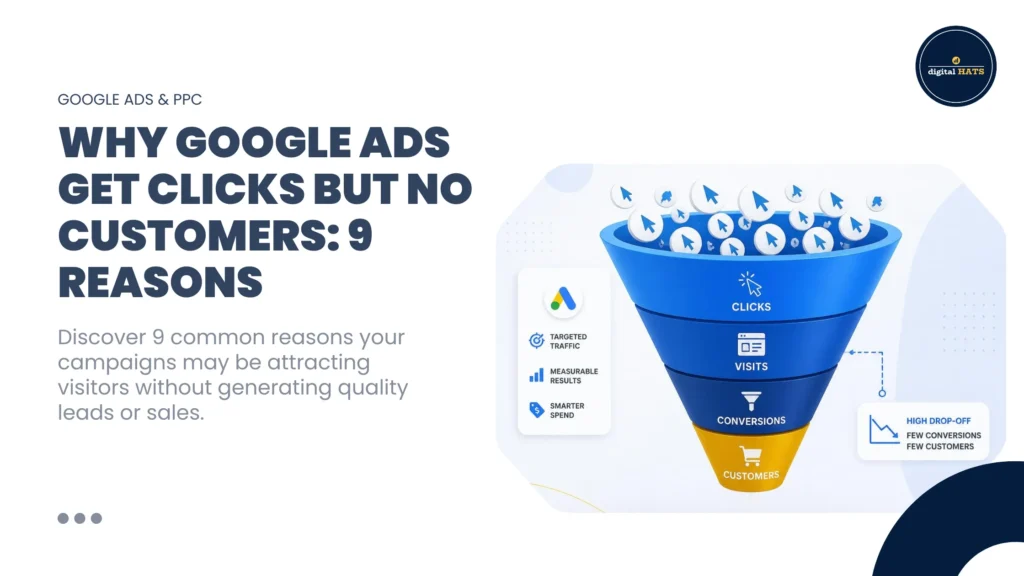
Instead of looking at clicks in isolation – look at the complete funnel –
Impressions → Clicks → Landing Page Visits → Conversions → Qualified Leads → Customers
“Each stage tells you something different.”
High impressions + low clicks
High impressions + low clicks
High clicks + low conversions
Investigate your landing page, offer, intent and user experience.
High conversions + poor-quality leads
Look at keyword targeting, search terms, geographic targeting and qualification.
Good leads + few customers
The problem may be outside the Google Ads campaign — for example, follow-up speed, sales process, pricing, offer or customer experience.
This is why simply asking “Are my Google Ads working?” is often the wrong question.
A better question is –
“Where are potential customers dropping out of the journey?”
How to Improve Google Ads Performance
If your campaigns are getting clicks but not customers – don’t immediately increase the budget.
Start with diagnosis.
Step 1: Review actual search terms
Find out what people are really searching before clicking your ads.
Step 2: Identify wasted traffic
Look for irrelevant searches, locations and audiences.
Step 3: Check your landing pages
Make sure the page matches the ad & makes the next step obvious.
Step 4: Verify conversion tracking
Make sure important actions are being recorded accurately.
Step 5: Analyse lead quality
Don't stop at the number of conversions. Find out "how many became genuine sales opportunities."
Step 6: Improve one variable at a time
Test your – Ad messaging, Keywords, Landing page, CTA, Offer, Audience, Geographic targeting.
This makes it easier to understand – what is actually improving performance.
Should You Stop Google Ads If You Are Not Getting Customers?
Not necessarily.
Google Ads can be highly effective – when the campaign is aligned with search intent, targeting, messaging, landing page experience and business goals.
But continuing to spend money without diagnosing the problem is unlikely to solve it.
If your campaign is receiving significant traffic, that traffic is already giving you useful information.
The question is “what the data is telling you.”
Maybe people are searching for the wrong things.
Maybe your landing page is creating friction.
Maybe your ads are attracting price shoppers.
Maybe conversion tracking is incomplete.
Or perhaps the campaign is generating good leads but your sales process needs attention.
The right answer comes from analysing the entire customer journey.
Final Takeaway
Google Ads getting clicks but no customers is usually a symptom – not the whole problem.
Clicks only tell you that someone was interested enough to visit.
They don’t tell you – whether that person had the right intent, understood your offer, trusted your business, completed a conversion or eventually became a customer.
That is why successful PPC advertising requires more than writing ads and choosing keywords.
You need the right combination of – keyword targeting, search intent, compelling ad copy, relevant landing pages, conversion tracking, lead qualification & continuous optimization.
If you are investing in Google Ads – measure what happens after the click.
Because the real objective isn’t more traffic.
It is more of the right customers.
FAQs – Google Ads Getting Clicks but No Customers
This can happen – when your keywords attract low intent searches, your landing page is not relevant enough, your offer is unclear, or your conversion process creates friction. Review search terms, landing page performance and conversion tracking before increasing your ad budget.
A click shows interest – but it does not guarantee purchase intent. Visitors may leave – because “the landing page does not match the ad, the offer is unclear, there is not enough trust information, or the contact process is difficult.”
Review your Search Terms Report and compare the people clicking your ads – with your ideal customer profile. Look for irrelevant searches, locations, services, audiences & low quality enquiries. Negative keywords and more specific targeting – can help reduce wasted traffic.
Not automatically. If clicks are not producing qualified leads or sales – increasing the budget may simply increase wasted spend. First identify – “where potential customers are dropping out of the conversion funnel.”
Conversions are generally more meaningful for a business than clicks – because they represent a desired action. However, businesses should also evaluate qualified conversions and actual customers, not just the number of form submissions or calls.
Yes. Even highly relevant ads can lose potential customers – if the landing page is “slow, confusing, poorly matched to the ad, difficult to use on mobile or missing a clear call to action.”
There is no universal number of days. The right timeframe depends on – budget, conversion volume, search demand and the type of business. Avoid making major decisions based on a handful of clicks; gather enough meaningful data to identify a pattern – while acting quickly on obvious issues such as irrelevant search terms or broken tracking.
Start by “tightening search intent & keyword targeting, reviewing search terms, adding negative keywords where appropriate, improving geographic targeting, making your ad copy more specific & sending visitors to relevant landing pages.” Then measure lead quality rather than only counting conversions.