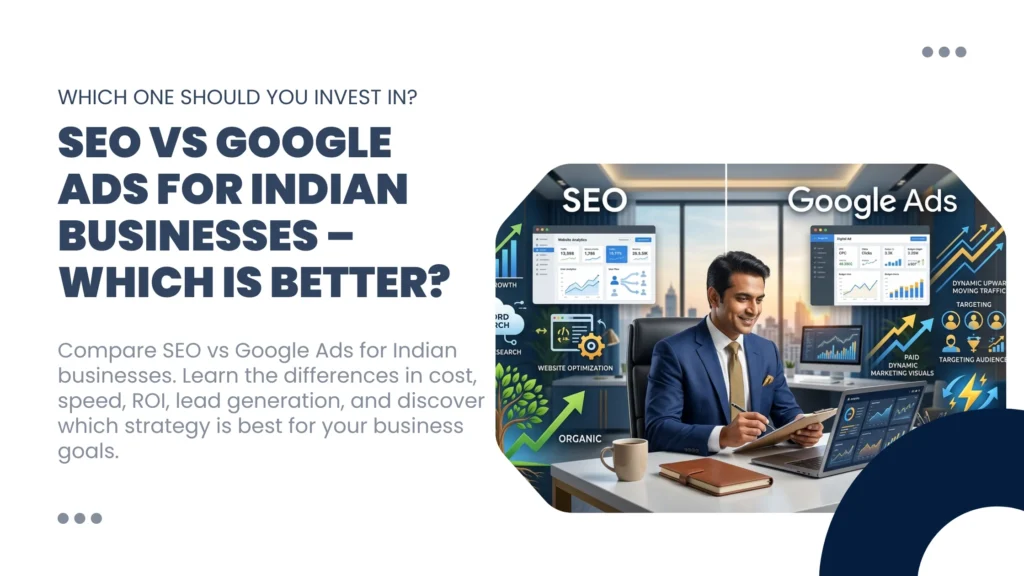
SEO vs Google Ads for Indian Businesses: Which One Should You Invest In?
Every business wants more customers.
The real question is –– how those customers should find you.
Some businesses want immediate enquiries and choose paid advertising. Others focus on long-term visibility through search engine optimisation. Many attempt both without understanding how each channel contributes to business growth.
The discussion around SEO vs Google Ads is often presented as if one strategy must defeat the other.
In reality, successful businesses “rarely” think this way.
Instead, they ask a more practical question –
“Which strategy matches our business goals today?”
The answer depends on your timeline, budget, competition, customer behaviour and growth ambitions.
This guide explains –– strengths, limitations, and ideal use cases for both SEO and Google Ads, helping Indian businesses make an informed marketing decision.
Understanding the Difference
Before comparing results – it’s important to understand how each channel works.
What Is SEO?
Search Engine Optimisation (SEO) improves your website’s ability to appear in organic search results –– when customers search for relevant products or services.
Unlike paid advertising –– SEO doesn’t involve paying for every visitor.
Instead, businesses invest in improving their website, creating valuable content, strengthening technical performance, and building authority over time.
For businesses looking to improve long-term online visibility –– professional SEO Services in India often combine technical optimisation, content strategy, local SEO, and ongoing performance analysis.
What Are Google Ads?
Google Ads allows businesses to appear in “sponsored” search results –– by bidding on keywords.
Instead of waiting for rankings to improve –– businesses can immediately reach customers searching for their services.
The advertiser pays –– when someone clicks on the advertisement.
This makes Google Ads particularly useful when immediate visibility is required.
However, traffic generally stops once advertising budgets are paused.
SEO vs Google Ads: The Fundamental Difference
Imagine opening two shops.
The first shop is located on a busy street where customers gradually begin recognising your business. Over time, more people recommend you, reviews increase, and footfall grows naturally.
The second shop rents a premium display area at the entrance of a shopping mall. Customers notice it immediately, but visibility disappears when the rental ends.
Neither approach is wrong.
They simply solve different business challenges.
SEO builds long-term discoverability.
Google Ads purchases immediate attention.
Side-by-Side Comparison
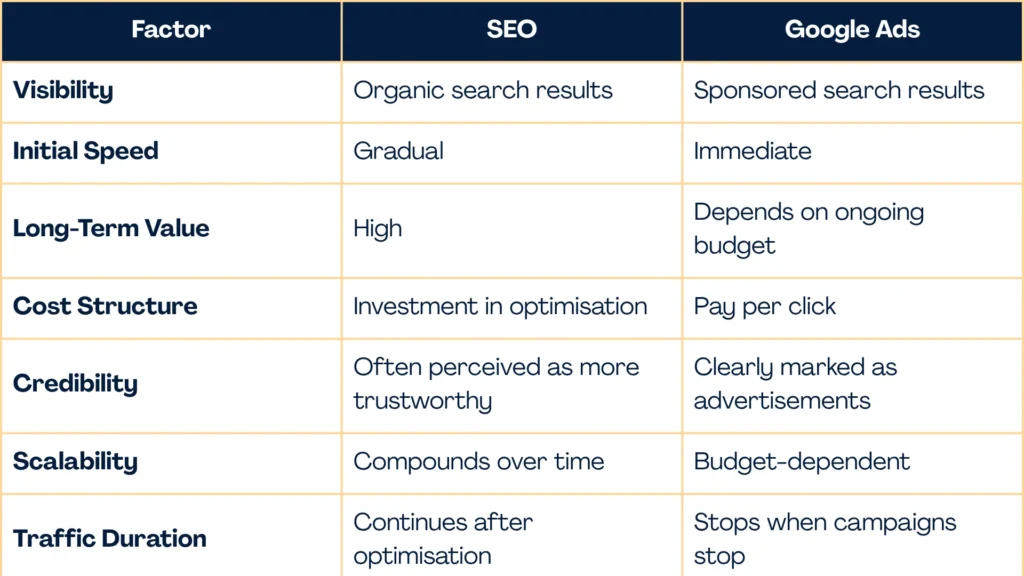
Instead of deciding which column looks better, businesses should identify which characteristics align with their objectives.
Comparing Cost: Investment vs Spending
Many businesses compare SEO and Google Ads purely on monthly costs.
This comparison is incomplete.
A more useful approach is understanding how money works differently in each strategy.
With SEO, businesses invest in assets:
- Website improvements
- High-quality content
- Technical optimisation
- Search authority
- Internal linking
- User experience
These improvements often continue delivering value months after the work is completed.
Google Ads operates differently.
Businesses allocate advertising budgets to purchase visibility.
Campaigns generate traffic quickly, but the visibility usually ends once the budget is exhausted.
Which Strategy Delivers Faster Results?
If speed is your only priority – Google Ads generally wins.
Campaigns can begin generating impressions and clicks shortly after approval.
SEO follows a different timeline.
Search engines need time to:
- Crawl pages
- Understand content
- Evaluate quality
- Compare competitors
- Build trust
Businesses entering competitive industries should expect SEO to be a long-term investment rather than an instant solution.
This doesn’t make SEO slower in a negative sense.
It simply means it compounds rather than spikes.
Which Builds More Trust?
An interesting observation from user behaviour is that many customers recognise the difference between advertisements and organic search results.
When businesses consistently appear organically for valuable industry topics, they gradually establish authority.
This doesn’t mean users ignore advertisements.
Instead, many customers discover businesses through ads and later return through organic search before making a purchase decision.
Trust is rarely built through one interaction.
It develops across multiple touchpoints.
Which Option Fits Different Business Types?
The answer depends on business objectives rather than industry alone.
Local Service Businesses
Examples include:
- Clinics
- Salons
- Repair services
- Consultants
Businesses serving local areas often benefit from combining Local SEO with targeted Google Ads for –– immediate enquiries.
Educational Institutions
Educational brands frequently experience seasonal admission periods.
SEO helps attract parents researching courses throughout the year.
Google Ads becomes particularly valuable during admission campaigns when immediate enquiries increase in importance.
Restaurants and Food Brands
Restaurants generally benefit from:
- Local SEO
- Google Business Profile optimisation
- Location-based advertising
Brands often use SEO to improve discoverability while –– running advertising campaigns for seasonal offers or new menu launches.
E-commerce Businesses
Online stores usually require both approaches.
SEO supports category pages, buying guides and product visibility.
Google Ads accelerates –– product launches, promotions and seasonal sales.
The two channels complement each other rather than compete.
Multi-City Businesses
Companies expanding into several cities often require a combination of:
- National SEO
- Local landing pages
- Paid campaigns
- Location-specific content
This integrated strategy becomes easier to execute when working with an experienced Digital Marketing Agency in India capable of coordinating multiple marketing channels.
A Decision Matrix Instead of a Debate
Rather than asking which strategy is better, ask which situation you’re facing.
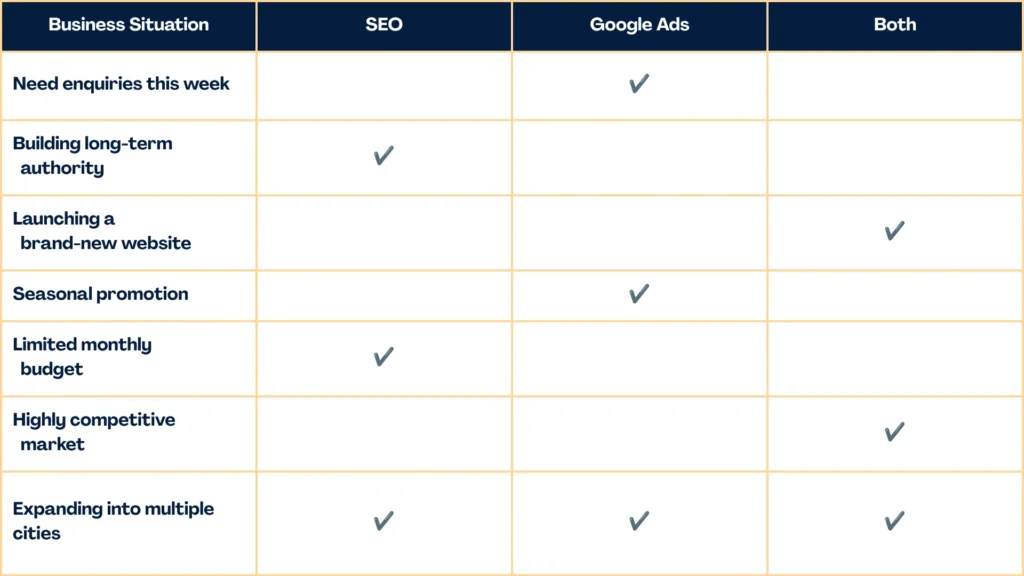
Notice something interesting.
Very few business scenarios require only one channel.
As businesses grow –– marketing strategies usually become more integrated rather than more specialised.
Which Delivers Better Return on Investment?
Return on investment is one of the most misunderstood aspects of digital marketing.
Many businesses compare SEO and Google Ads by asking a simple question:
“Which gives more leads?”
A better question is:
“Which creates more business value over time?”
Google Ads often generates enquiries quickly because –– your business appears in front of customers actively searching for your services.
SEO takes longer to gain momentum –but every improvement you make –– whether it’s publishing helpful content, improving website performance, or strengthening technical SEO continues to contribute to future visibility.
Think of it this way:
- Google Ads rents visibility.
- SEO builds visibility
Neither approach is inherently superior. They simply create value in different ways.
When SEO Is the Better Investment
SEO is generally a stronger choice when your business:
- Wants consistent enquiries throughout the year.
- Plans to grow organically.
- Operates in a competitive industry.
- Wants to become a recognised authority.
- Is willing to invest patiently.
SEO is particularly effective for businesses –– where customers research before making decisions.
Examples include:
- Educational institutions
- Healthcare providers
- Professional services
- B2B companies
- Real estate consultants
These customers rarely purchase immediately. They compare, research, revisit websites, and build confidence before making contact.
SEO supports this behaviour exceptionally well.
When Google Ads Makes More Sense
Google Ads becomes highly valuable when speed matters.
Examples include:
New Business Launch
A newly launched website usually has little search visibility.
Google Ads can begin generating visitors while SEO efforts are developing.
Seasonal Campaigns
Admission season.
Festival offers.
Product launches.
Limited-time discounts.
Paid advertising helps –– businesses capture demand during specific periods.
Testing New Markets
Before investing heavily in SEO for a new city or service, businesses can use Google Ads to understand customer demand and conversion behaviour.
This reduces uncertainty before making larger long-term investments.
Why the Best Strategy Is Often Both
One of the biggest misconceptions in digital marketing is –– treating SEO and Google Ads as competing channels.
In reality, they solve different stages of business growth.
A practical example:
A potential customer searches for a service.
They click your Google Ad.
They visit your website.
A few days later, they search your company name.
They read one of your blog articles.
Later, they return through an organic search result and finally submit an enquiry.
Which channel generated the customer?
The answer is:
Both contributed.
This is why integrated marketing strategies consistently outperform isolated tactics.
Businesses that combine organic visibility with paid campaigns often create –– stronger brand recall, higher trust, and more consistent enquiry generation.
The Website Still Determines Success
Whether visitors arrive through SEO or Google Ads –– they eventually land on your website.
If the website loads slowly, lacks clear messaging, or creates confusion –– both strategies lose effectiveness.
Before increasing marketing budgets –– businesses should ensure they have a website capable of converting visitors into enquiries.
Working with an experienced Website Design Company in India can help improve –– user experience, navigation, page speed, mobile responsiveness, and conversion pathways—factors that influence both organic and paid performance.
The Most Common Mistakes Businesses Make
Treating SEO as a One Time Activity
SEO is not a checklist that ends after a few weeks.
Search behaviour changes.
Competitors publish new content.
Algorithms evolve.
Regular optimisation keeps your website competitive.
Running Google Ads Without Conversion Tracking
Clicks alone don’t measure success.
Businesses should monitor:
- Enquiry forms
- Phone calls
- WhatsApp enquiries
- Purchases
- Lead quality
Without conversion tracking, advertising decisions become guesswork.
Ignoring Content
Some businesses expect SEO results without publishing useful information.
Content helps answer customer questions, demonstrates expertise & strengthens topical authority.
It’s also one of the reasons businesses increasingly appear in AI-powered search experiences.
Expecting Immediate SEO Rankings
Search engines reward consistency rather than shortcuts.
Publishing one blog or optimising a handful of pages rarely – transforms visibility overnight.
Sustainable SEO is built through continuous improvements.
Choosing Channels Based Only on Budget
Businesses often ask:
“We have ₹30,000. Should we spend it on –– SEO or Google Ads?”
A more useful discussion is:
“What business objective should ₹30,000 help us achieve?”
Marketing decisions should begin with business goals—not simply available funds.
A Practical Framework for Indian Businesses
Use this framework when deciding where to invest.
Invest More in SEO If:
- Your website already receives some traffic.
- You want sustainable long-term growth.
- Customers research before purchasing.
- You want to reduce dependence on paid advertising over time.
- Brand credibility is important.
Invest More in Google Ads If:
- You need enquiries quickly.
- You're launching a new service.
- You're entering a new city.
- You have seasonal campaigns.
- Immediate lead generation is a priority.
Invest in Both If:
- You want consistent growth.
- Your business is expanding.
- Competition is increasing.
- You want to dominate both paid and organic search visibility.
Many businesses eventually reach this stage where combining channels produces stronger results than relying on one alone.
Building a Marketing Strategy Instead of Choosing a Side
The question isn’t:
“SEO or Google Ads?”
The better question is –
“How should these channels work together for my business?”
For example:
- SEO attracts customers researching solutions.
- Google Ads captures immediate demand.
- Social media builds familiarity.
- A well designed website converts visitors.
- Analytics identifies opportunities for improvement.
This integrated approach is often easier to execute with a Digital Marketing Agency in India that can coordinate multiple channels under one strategy instead of treating each activity independently.
Indian Businesses evaluating potential partners may also find our guide on –– How to Choose a Digital Marketing Agency in India: 15 Questions Every Business Must Ask helpful before making a long-term decision.
FAQs
1. Which is better for small businesses in India: SEO or Google Ads?
It depends on your goals. SEO is often suitable for businesses seeking long-term visibility ––while Google Ads helps generate enquiries more quickly. Many small businesses benefit from combining both over time.
2. How long does SEO take compared to Google Ads?
Google Ads can begin driving traffic shortly after campaigns go live. SEO usually requires several months to build authority and improve rankings –– especially in competitive industries.
3. Is SEO cheaper than Google Ads?
The pricing models are different. SEO involves investing in optimisation and content –whereas Google Ads charges for clicks. Long-term costs and returns vary depending on –– competition and business objectives.
4. Can I run Google Ads while doing SEO?
Yes. In fact, many businesses use Google Ads for “immediate visibility” while SEO builds “sustainable” organic traffic. The two strategies –– often work well together.
5. Should new businesses choose SEO or Google Ads first?
Many new businesses start with Google Ads to generate initial enquiries –while simultaneously investing in SEO for long-term growth.
People Also Ask
Does SEO provide better ROI than Google Ads?
For businesses focused on long-term growth –– SEO often delivers increasing value over time. Google Ads, however, can provide faster returns for time sensitive campaigns. The better ROI depends on your objectives.
Can Google Ads improve SEO rankings?
No. Running Google Ads does not directly improve organic rankings. SEO and paid advertising operate independently –– although they can support the same overall marketing strategy.
Is SEO still worth investing in during 2026?
Yes. As customers continue searching for products and services online ––SEO remains one of the most effective ways to build sustainable visibility and authority.
Which industries benefit most from SEO?
Industries where customers research before purchasing such as –– education, healthcare, professional services, and B2B often see significant long-term value from SEO.
Can SEO and Google Ads be managed together?
Absolutely. Combining SEO with Google Ads allows businesses to capture immediate demand ––while steadily increasing organic visibility, creating a more balanced and resilient marketing strategy.