What Does a Digital Marketing Agency Actually Do? A Complete Guide for Businesses
Many business owners know they need –– digital marketing.
Fewer know what a digital marketing agency actually does on a day to day basis.
This knowledge gap often creates unrealistic expectations.
Some businesses assume an agency’s only job is –– posting on social media. Others believe hiring an agency automatically guarantees leads and sales. Many expect immediate results within a few weeks.
The reality is different.
A digital marketing agency is not simply a service provider. The right agency functions as a growth partner –– that helps businesses attract attention, build credibility, generate demand, and convert prospects into customers.
To understand what a digital marketing agency actually does –– it helps to think about the customer journey.
Before someone buys from your business, they usually go through several stages:
- They discover your business.
- They compare you with alternatives.
- They evaluate trust.
- They contact you or make a purchase.
A digital marketing agency influences each of these stages.
Let’s explore how.
What Is a Digital Marketing Agency?
A digital marketing agency helps businesses grow through online channels.
Instead of relying entirely on traditional advertising –– businesses use agencies to improve their visibility across search engines, websites, social platforms, paid advertising platforms, and content channels.
A full-service Digital Marketing Agency in India generally manages multiple activities simultaneously.
These activities may include:
- Search Engine Optimization (SEO)
- Social Media Marketing
- Website Design and Development
- Google Ads Management
- Content Marketing
- Local SEO
- Analytics and Reporting
- Conversion Optimization
The exact mix depends on business goals.
For example, a local restaurant and a multi-city education brand rarely require the same strategy.
A Digital Marketing Agency Helps Businesses Get Found
One of the most important responsibilities of an agency is improving visibility.
Many businesses have excellent products and services -but remain invisible online.
When customers search:
- “best spoken English classes near me”
- “healthy meal delivery in Faridabad”
- “digital marketing agency in India”
they usually contact businesses they can easily discover.
Improving discoverability is often the starting point.
Agencies achieve this through multiple channels.
1. Search Engine Optimization (SEO)
Search engine optimization remains –– one of the most important services offered by agencies.
SEO helps businesses improve their visibility in search engines –– when customers look for relevant products or services.
However, SEO is much more than –– adding keywords to webpages.
Professional SEO usually involves several components.
A. Technical SEO
Technical improvements ensure that –– search engines can efficiently crawl & understand a website.
Examples include:
- Website speed optimization
- Mobile responsiveness
- Crawlability improvements
- Structured data implementation
- Indexing issue resolution
Businesses frequently underestimate technical issues.
Even strong content may struggle if search engines cannot properly access important pages.
B. Content Strategy
Modern SEO depends heavily on content depth.
Agencies typically conduct:
- Keyword research
- Search intent analysis=
- Content gap analysis
- Competitor research
This research helps identify opportunities for new pages, blogs, and resources.
For example, businesses seeking national visibility often invest in dedicated SEO Services in India alongside ongoing content development.
C. Local SEO
Local businesses require a different SEO approach.
Local SEO activities often include:
- Google Business Profile optimization
- Local citations
- Review management
- Location page optimization
Local visibility can significantly influence inquiries for businesses serving specific cities or regions.
2. Social Media Marketing
Many businesses associate agencies primarily with social media.
While social media is important, effective social media management involves much more than publishing attractive graphics.
A Social Media Marketing Agency in India generally focuses on:
A. Content Planning
Agencies create content calendars aligned with business goals.
Content categories may include:
- Educational posts
- Brand stories
- Customer testimonials
- Industry insights
- Promotional campaigns
B. Creative Development
Agencies design:
- Graphics
- Carousels
- Reels
- Videos
- Stories
The objective is not simply aesthetics.
Content should support broader business goals such as –– awareness, engagement, or lead generation.
C. Community Management
Responding to comments, messages and customer interactions helps strengthen brand relationships.
Businesses increasingly expect agencies to assist with community engagement.
D. Paid Social Campaigns
Many agencies also manage paid advertising across social platforms.
Campaign objectives may include:
- Lead generation
- Website traffic
- Event registrations
- Brand awareness
3. Website Design and Development
A website is often the most important digital asset a business owns.
However, many businesses invest heavily in marketing -while ignoring website quality.
This creates a problem.
Marketing campaigns may successfully attract visitors, but poor websites frequently fail to convert those visitors into customers.
A Website Design Company in India often supports businesses through:
A. Website Design
Creating visually appealing & user-friendly websites.
B. User Experience Improvements
Improving:
- Navigation
- Information structure
- Mobile usability
- Conversion pathways
C. Landing Page Development
Dedicated landing pages are often created for advertising campaigns.
D. Website Redesign
Businesses periodically redesign websites to align with –– changing customer expectations.
A modern website should support both user experience and business objectives.
4. Google Ads and Paid Advertising Management
Search engine optimization builds long-term visibility.
Paid advertising delivers faster visibility.
Agencies commonly manage:
- Google Search Ads
- Display Ads
- YouTube Ads
- Remarketing Campaigns
Paid campaigns require continuous optimization.
Activities often include:
- Keyword selection
- Ad copy testing
- Audience refinement
- Budget allocation
- Conversion tracking
Successful advertising rarely happens through “set and forget” campaigns.
Continuous improvement is essential.
5. Content Marketing
Content marketing has become central to digital growth.
Businesses increasingly need content that demonstrates –– expertise and builds trust.
Agency content activities may include:
- Blog writing
- Service pages
- Industry pages
- Case studies
- Email content
- Website copy
Strong content serves multiple purposes simultaneously.
It can:
- Improve rankings
- Educate prospects
- Build credibility
- Support sales conversations
Educational businesses, for example, often rely heavily on content to answer parent concerns before inquiries occur.
6. Analytics, Reporting and Performance Tracking
Digital marketing without measurement is guesswork.
Professional agencies spend considerable time analyzing performance.
Common reporting areas include:
- Website traffic
- Lead generation
- Conversion rates
- Keyword rankings
- Advertising performance
- Engagement metrics
However, data alone is insufficient.
Businesses require interpretation.
The most valuable agencies explain:
- What happened
- Why it happened
- What actions should happen next
This strategic interpretation frequently differentiates experienced agencies from –– execution-only vendors.
7. Conversion Optimization
Generating traffic is only part of the process.
Visitors must eventually take action.
Agencies increasingly help businesses improve:
- Inquiry forms
- Call-to-action placement
- Website messaging
- Landing page structure
- Customer journeys
Small conversion improvements often produce significant business impact.
For instance, improving a landing page conversion rate from 2% to 4% effectively doubles lead generation without –– increasing traffic.
What a Digital Marketing Agency Does NOT Do
This distinction is equally important. A digital marketing agency cannot:
Guarantee
Rankings
- Search engines control rankings, not agencies.
- Be cautious of absolute guarantees.
Deliver Overnight Success
- Sustainable growth typically requires time.
- SEO, content, and brand-building activities often produce results gradually.
Replace Product Quality
- Marketing amplifies customer experiences.
- If products or services consistently disappoint customers, marketing alone cannot solve the problem.
Replace Internal Sales Processes
- Leads still require follow up, nurturing and closing.
- Businesses play a critical role in –– converting opportunities into revenue.
How Different Businesses Use Agencies Differently
Not every business uses agencies in the same way.
Educational Brands
Educational businesses frequently prioritize:
- SEO
- Content marketing
- Trust-building content
For example, brands such as LearnifyU often rely on educational resources, location pages, and search visibility to attract parents researching programs.
Food and Hospitality Businesses
Brands similar to NutriNest often prioritize:
- Social media
- Local SEO
- Visual storytelling
- Reputation management
Coaching and Training Institutes
Institutions such as KK Learning Minds typically focus on:
- Credibility-building websites
- Student inquiry generation
- Local visibility
Understanding these differences allows agencies to develop –– more relevant strategies.
When Should You Hire a Digital Marketing Agency?
Businesses commonly hire agencies when:
- Website inquiries decline.
- Growth stagnates.
- Internal expertise is limited.
- Competitors dominate search visibility.
- Existing marketing efforts lack direction.
Businesses evaluating whether to build internal teams or partner externally may also find it useful to compare –– in-house marketing teams with agency partnerships before making a decision.
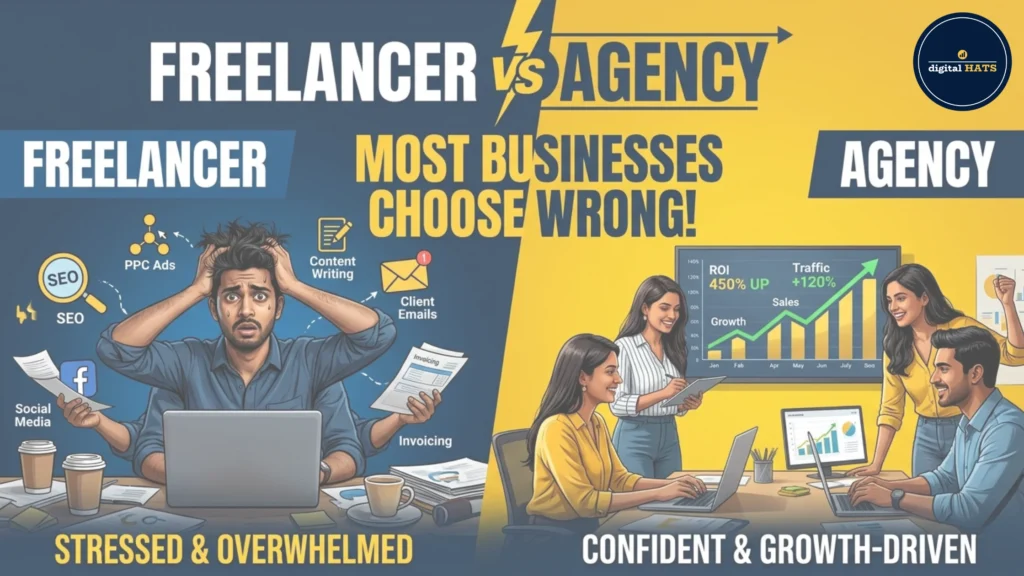
Agency vs Freelancer vs In-House Team
Freelancers
Suitable for:
- Small projects
- Limited budgets
Challenges:
- Limited specialization
- Scalability constraints
In-House Teams
Suitable for:
- Larger organizations
- Dedicated marketing functions
Challenges:
- Recruitment costs
- Training requirements
Agencies
Suitable for:
- Businesses seeking broader expertise
- Businesses requiring integrated strategies
Advantages:
- Multi disciplinary teams
- Strategic oversight
- Scalability
Choosing the right model depends on –– business objectives, resources & growth ambitions.
The Key Takeaway
A digital marketing agency does far more than –– manage social media accounts or run advertisements.
The right agency helps businesses become –– easier to find, easier to trust and easier to choose.
The most successful agency relationships occur –– when businesses view agencies not as vendors, -but as long term growth partners.
Before hiring an agency –– businesses should understand both what agencies do and what realistic expectations look like.
This understanding creates –– stronger partnerships and better business outcomes.
FAQs
1. What does a digital marketing agency do for a business?
A digital marketing agency helps businesses improve online visibility, generate leads, build brand awareness and support growth through channels –– such as SEO, social media, paid advertising and content marketing.
2. What services do digital marketing agencies offer?
Services commonly include –– SEO, social media marketing, website design, paid advertising, content marketing, analytics, and conversion optimization.
3. Is hiring a digital marketing agency worth it?
For many businesses –– agencies provide specialized expertise and strategic support that may be difficult to build internally.
4. How do digital marketing agencies measure success?
Success is usually measured through metrics such as –– leads, traffic, conversions, rankings, revenue impact and campaign performance.
5. How long does it take to see results from digital marketing?
Timelines vary depending on the channel. Paid advertising can produce results quickly, –while SEO and content marketing generally require longer-term investment.
People Also Ask
What is the role of a digital marketing agency?
A digital marketing agency helps businesses –– attract, engage and convert customers through “online marketing channels”.
Do digital marketing agencies create websites?
Many full-service agencies provide –– website design, development, and landing page creation services.
Can a digital marketing agency guarantee leads?
No agency can guarantee leads because outcomes depend on multiple factors –– including market conditions, competition, product quality, and budget.
What is the difference between a freelancer and a digital marketing agency?
Freelancers usually provide specialized support, while agencies offer broader expertise through multi-disciplinary teams.
Should small businesses hire a digital marketing agency?
Small businesses often benefit from agency support because it provides access to specialized skills without hiring full in-house teams.